
An Ode to the Teaches of Peaches - How Modern Pop Music Is Influenced by the Queer Innovator
Words: Elsie Oulton
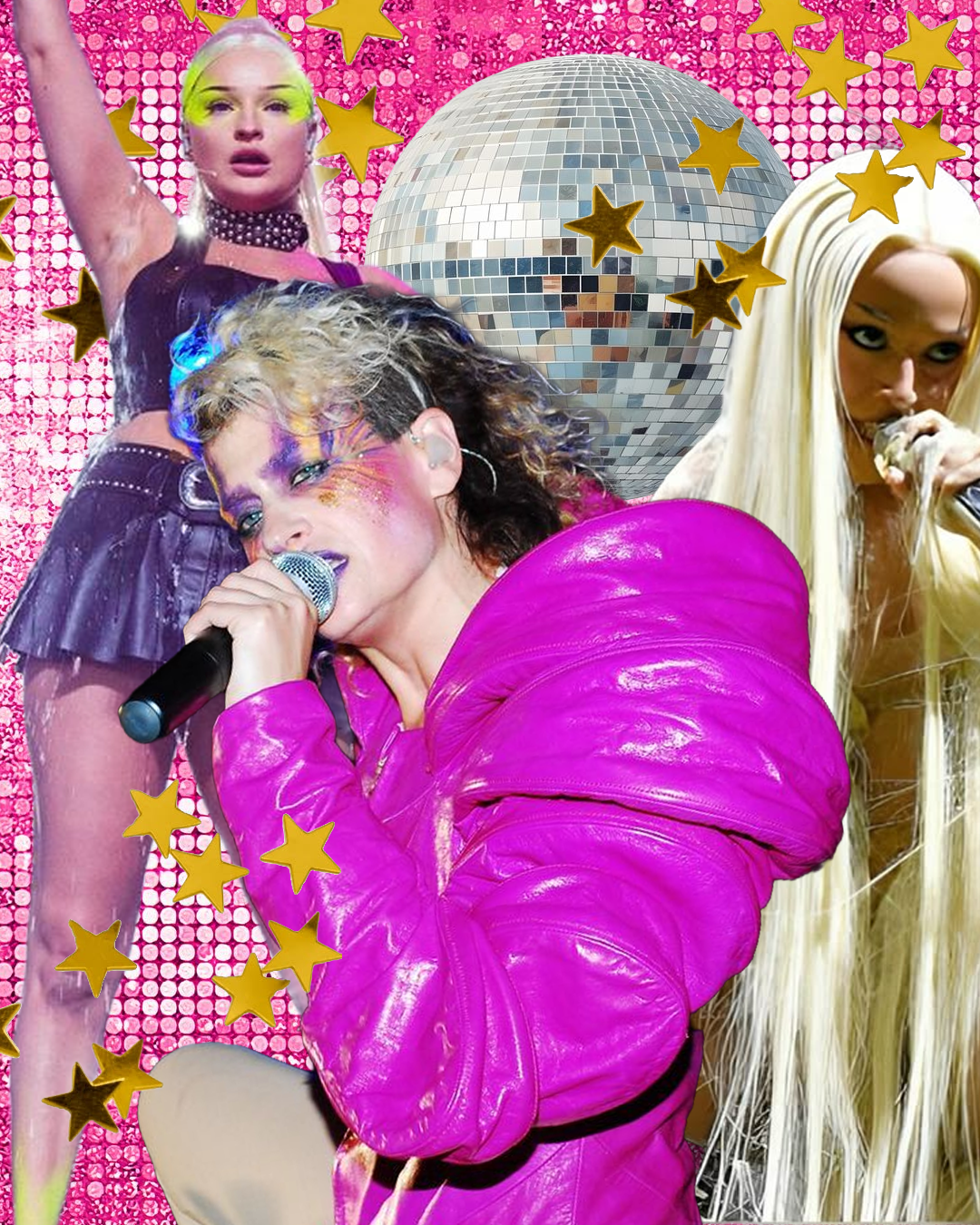
As one of the ‘spotlight’ headliners of this year's Great Escape Festival in Brighton, Peaches more than proved herself a harbinger of today’s queer, cunty pop and techno gals; the Canadian electroclash powerhouse walked so Miss Bashful, COBRAH and even Chappell Roan could not only run, but frolic. Peaches was proto-everything. The current climate of glitchy, crass and consciously vulgar performances of femininity, now increasingly naturalised - at least in my queer, chronically-online circles - is exactly what rendered her an outlier 25 years ago. Now, the likes of Kim Petras and Slayyyter take up the baton; a quarter of a century on from her seminal debut The Teaches of Peaches, the mainstream seems to be crawling its way towards her.
Whilst sonically worlds apart, her influence can be seen in the rise of Doechii; the Florida rapper shares Peaches’ commitment to a form of womanhood that is delightfully theatrical and unbridled. Sexuality in Doechii’s music is never presented as passive desirability, instead she arrives at something purposefully, performative and occasionally grotesque. Like Peaches before her, she treats femininity as a site of experimentation as opposed to a fixed identity that has to be inhabited ‘correctly’. Even the release of ‘Runway’ as part of the Devil Wears Prada 2 soundtrack with Lady Gaga holds significance: folding the bolshy, lesbian rap icon into a high-flying, ‘trad’ film campaign acts as a litmus test for how feisty, queer sexuality is viewed in 2026. The fact that such an artist can now exist and play around at the centre of pop culture suggests just how dramatically the boundaries around female sexual expression have shifted since Peaches initially released her debut.
Theatrical by default, Gaga also continues Peaches’ lineage: excessive, operatic and consciously uncanny. Alongside her explicit declarations of sexuality (and bisexuality - despite years of low-level, public bi-erasure), she embraced the outlandish possibilities of pop performance as a way to push mainstream femininity towards something grittier, more bizarre and less ‘palatable’. This inheritance also extends to Chappell Roan, whose construction of sexuality feels genuinely radical in today’s pop landscape. The drag-popstar does not perform desirability through bodily exposure - instead, she adds layers on top - burying herself beneath wigs, makeup, costumes and drag exaggerations. In early 2024 she wore a lavish medieval ensemble complete with a pig snout to the Universal Music Party (re-worn for the Good Luck Babe single art), and shares a love of ‘tacky’, DIY aesthetics with Peaches. Roan’s sexuality is built up, layer by layer, for women, queer audiences and herself, as opposed to being stripped down for a predominantly ‘male-gaze’. In doing so, she defies expectations that female sexuality be smooth and legible, whilst embracing the heightened, bizarre aesthetics that artists such as Peaches made possible.
___STEADY_PAYWALL___
“In retrospect, Peaches’ bodily obsessions feels less like provocation for provocation’s sake and more an early blueprint for the abrasive hyperfemininity now dominating the cunty techno underground, as well as pop.”
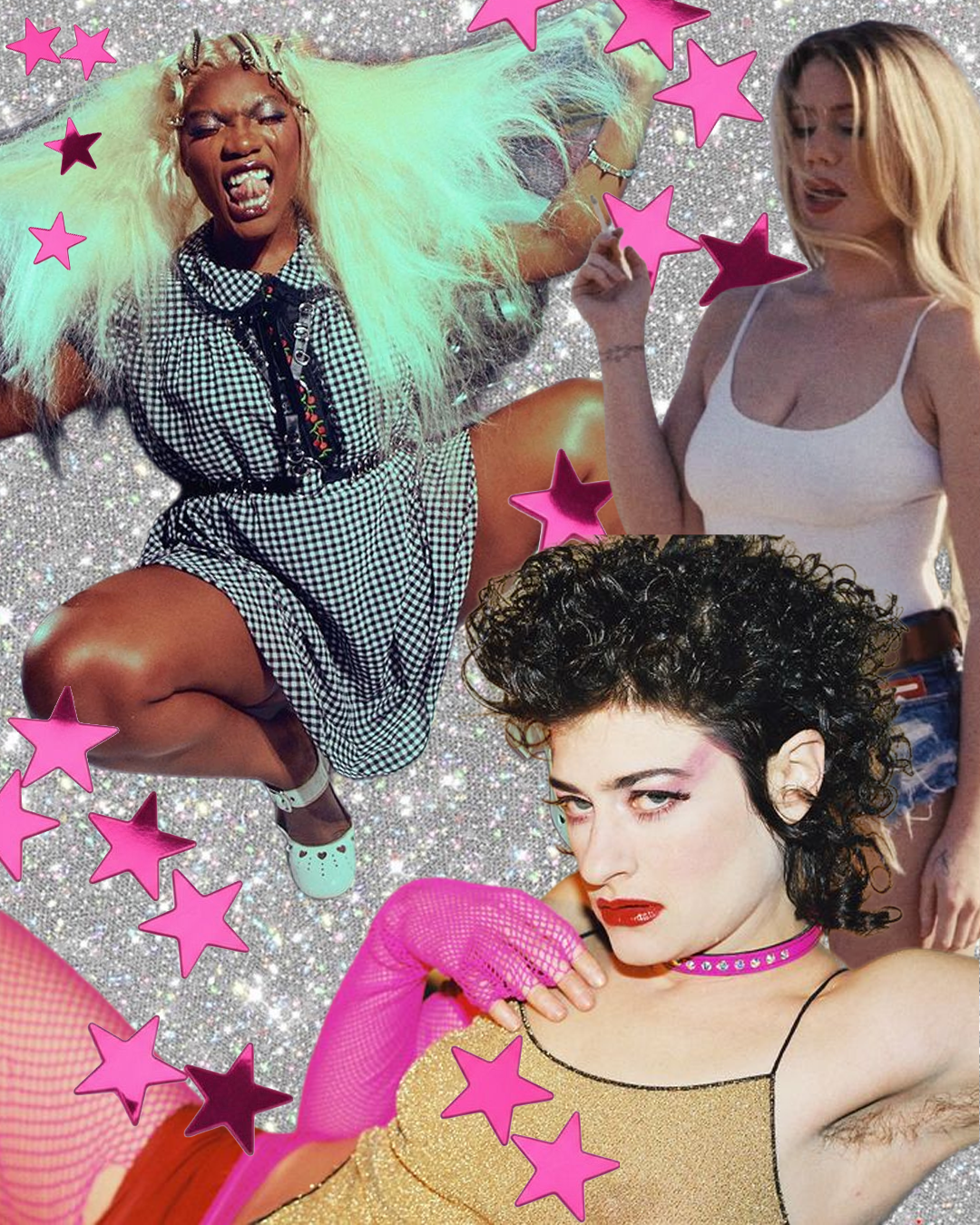
These artists are helping to build a new erotic language, one of irreverence and glut;
Chappell, Gaga, Peaches - add to their bodies and adorn them, whilst amplifying the absurdity of human anatomy. The erotic is increasingly detached from flesh, found instead in puffed fabric, a beige penis suit, or drag. “I would have multiple breasts. I would have a breast on my vagina” Peaches breezily noted of her early costumes on last year’s Talk Art podcast; in Brighton she wore strap-ons, pubic hair suits, and what seemed like a small-intestine costume - the ‘theme’ of her new live show is ‘prolapse’, after all.
Her fascination with body hair goes back to the start of her career; Peaches would wear tight, pink body suits - a deliberate play on legible femininity, and all people could talk about was her pubic hair sticking out. Bombarded with images and discourse, her response was to simply ramp up the volume of hair onstage. Pubic hair as costume was a springboard for ever-more absurd, hairy suits, as she challenged the norms around where hair was ‘allowed’ to be long on bodies. In 2024, during her Coachella headline set, Doja Cat performed hit ‘Demons’, shrouded in similarly absurd hair suits - Where the Wild Things Are-meets-female rap. The same set ended with Doja writhing on a mud-drenched, construction-site-esque B-stage as she performed ‘Wet Vagina’, orgiastically interacting with her crew of female dancers; Peaches’ fingerprints were all over it.
In retrospect, Peaches’ bodily obsessions feels less like provocation for provocation’s sake and more an early blueprint for the abrasive hyperfemininity now dominating the cunty techno underground, as well as pop. Artists like Kim Petras, Miss Bashful and Chase Icon have inherited this fascination with femininity and the female body which is not only injected with camp, but amplified into something confrontational and harsh. Speaking to the Recording Academy in 2023, Petras cited Peaches as early inspiration for her ‘Slut Pop’ universe :‘I grew up listening to the dirtiest s***...I listened to Ayesha Erotica so much - to Peaches, to, like, Amanda Lepore’s quick dip into music’. Hearing ‘Peaches’ in the same breath as contemporary, trans SoundCloud baby Ayesha Erotica shows just to what degree The Fuck The Pain Away singer created a template for this strain of confrontational, sex-first, DIY electronic femininity. Additionally, the recent explosion of Slayyyter into the mainstream affirms this strain as foundational to contemporary queer and femme-forward pop and club music; not only have these aesthetics and themes become normalised, they’re now lauded on a larger scale.
Alternatively, Sabrina Carpenter muddies Peaches’ influence far beyond these left-field, ‘weird’ girls. As a seemingly heterosexual, blonde pin-up, Sabrina reveals how the aesthetics and attitudes of Peaches have seeped into the general pop universe. Her horny musical offerings suggest that polished pop femininity is not merely passive and saccharine, but can exhibit an overt sexual appetite. Not only did Peaches spearhead camp horniness, she broke the mould of pop performance and subsequently helped reshape the conditions under which femininity, queerness and sexual performance could operate within pop culture. As a song on her new album No Lube, So Rude declares: “Fuck How You Wanna Fuck”, and that radical agency and choice is a call to arms: not only for sex, but for female identity. Regularly, she acknowledges and champions new female acts; closing her set, she brought out Lambrini Girls frontwoman Phoebe Lunny for Fuck the Pain Away, screaming “Do you know how much I love Phoebe, how cool her band is?” and “Give it up for Lambrini Girls!”, before scampering off with a flick of her pubic hair tail.
Meanwhile, pop’s Lesbian Renaissance marches on: Towa Bird just released her sophmore album, “Talking about sex is an active act of liberation and resistance, especially for lesbians, because it's fucking rare”, as she told Cosmopolitan, and MUNA's fourth album ‘Dancing on the Wall’ dropped a week later- a positive deluge from the Sapphic gods. The latter sits firmly in the Peaches canon, exploring the sweaty thrill of lesbian desire whilst mournfully acknowledging the ways in which queer people are increasingly at danger, and the political devastation in which we find ourselves. What once rendered Peaches genuinely transgressive now forms the aesthetic language of an entire generation of femme pop and electronic artists, with hypersexuality pushed to absurdity and queerness as an all-encompassing default.