Erik Charlotte’s Eponymous Brand Makes the Female Form Fun Again
Creative Direction, Photography and Words: Allie Pilcher | Designer & Model: Erik Charlotte | Production Coordinator: Odin Frostad | Makeup Artist: Kayli Rachelle | Hairstylist: Emma Croft | Gaffer: Christopher Mortenson | Set Dresser: Isabella Monge
If the female body is a temple, the female form has also never been sacred. We’ve been simultaneously worshipping and weaponising it in the same breath; idolising and policing the figure without even joining the payroll.
We cancelled the Victoria’s Secret fashion show for promoting unattainable standards, then erupted when it pivoted towards inclusivity. We traded “heroin chic” for an Ozempic pandemic. Half of us view sexually-charged silhouettes as male-oriented objectification, while the other half see them as feminist liberation.
As we debate whether our obsession with the feminine silhouette is oppression or empowerment, we make fashion an inevitable scapegoat. Contradiction, it seems, is the only constant condition of femininity. Few designers make work that embodies that paradox more vividly than Erik Charlotte.
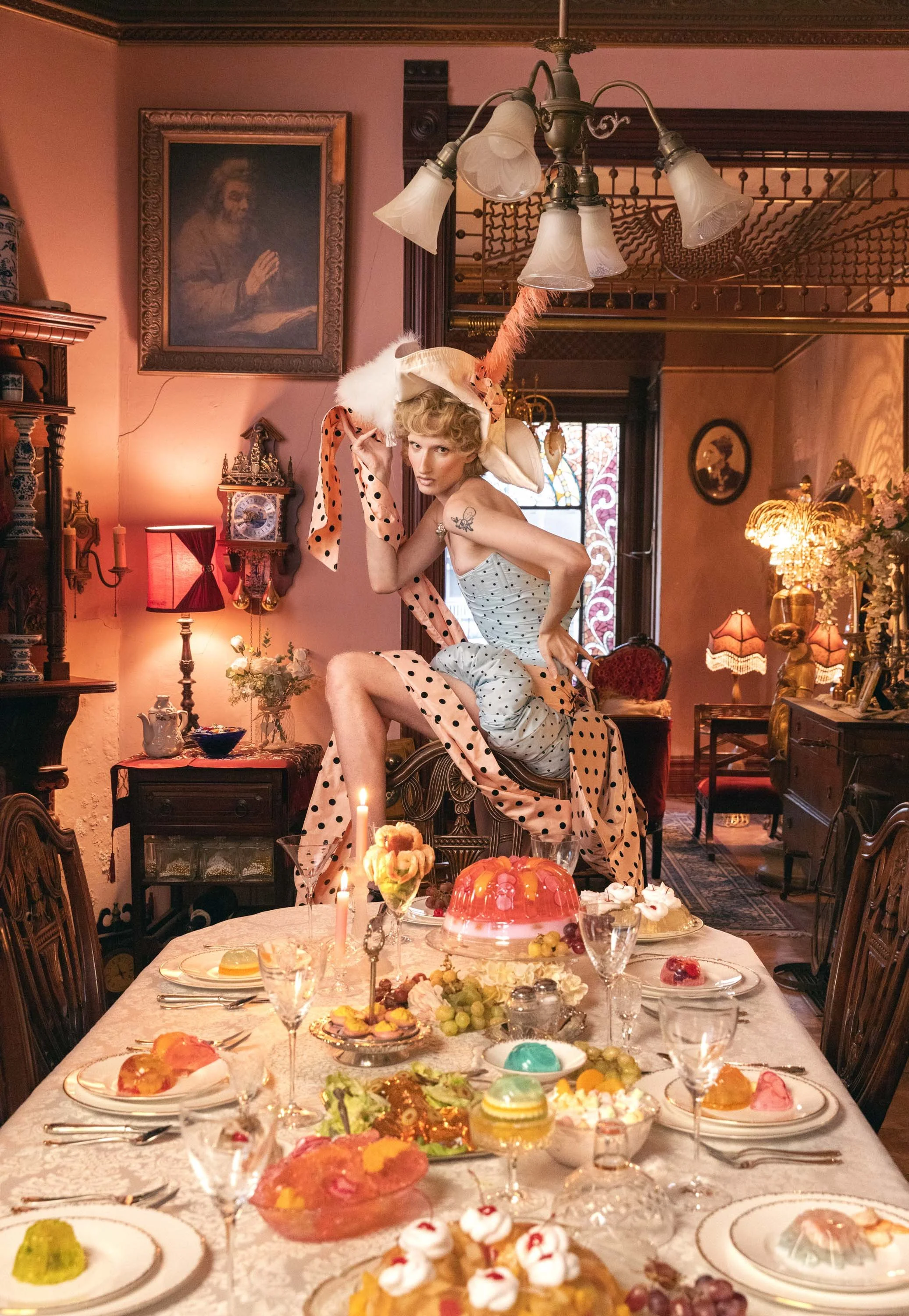
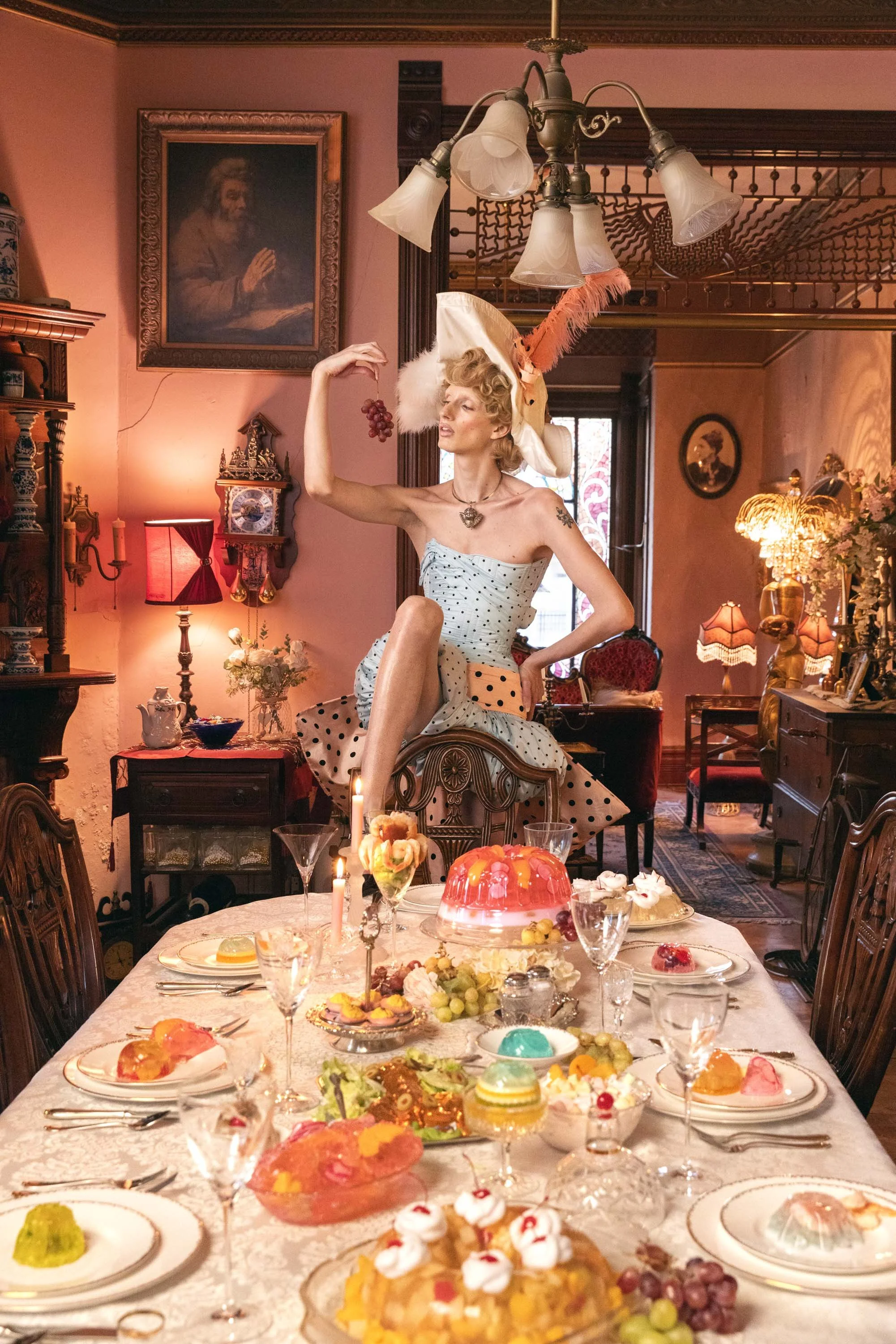
The discourse around femininity has always been one about spectacle, and Erik’s work exaggerates the feminine form until it becomes theatrical: it isn't parody so much as exposure. By amplifying the illusion she compels us to confront our own perceptions. Her silhouettes are engineered confections, her materials architecturally poised, and her palette a nod to restraint. It’s an empowered reinterpretation of the feminine ideal that Erik echoes in her own philosophy: “I think femininity is just inherently unattainable,” she says. “When I approach femininity in my work, I want it to be this big, grandiose thing.”
“I think about everything we do to restrict women’s bodies. I want to make sure that my corsets are ridiculous so you're not wearing it to please society, you’re wearing it because it's ridiculous, because it looks cool, because it's exaggerated.”
Erik’s approach to form and function sits within a centuries-long lineage of constructed ideals. That history expands across corsets and panniers to the Bombshell Bra and BBLs, each reimagined through the illogic of exaggeration. Erik Charlotte’s world simultaneously succeeds and challenges that history.
We like to pretend that feminine ideals evolve with the times, but most of them just return with better branding. SKIMS didn’t invent shapewear any more than the pierced bra or the faux hair thong invented provocation - they’re just new costumes for old taboos. The medium shifts, but the silhouette stays the same. Erik’s work is refreshing, because she commits to the overt, performative absurdity of feminine form instead of pretending the act doesn’t exist.
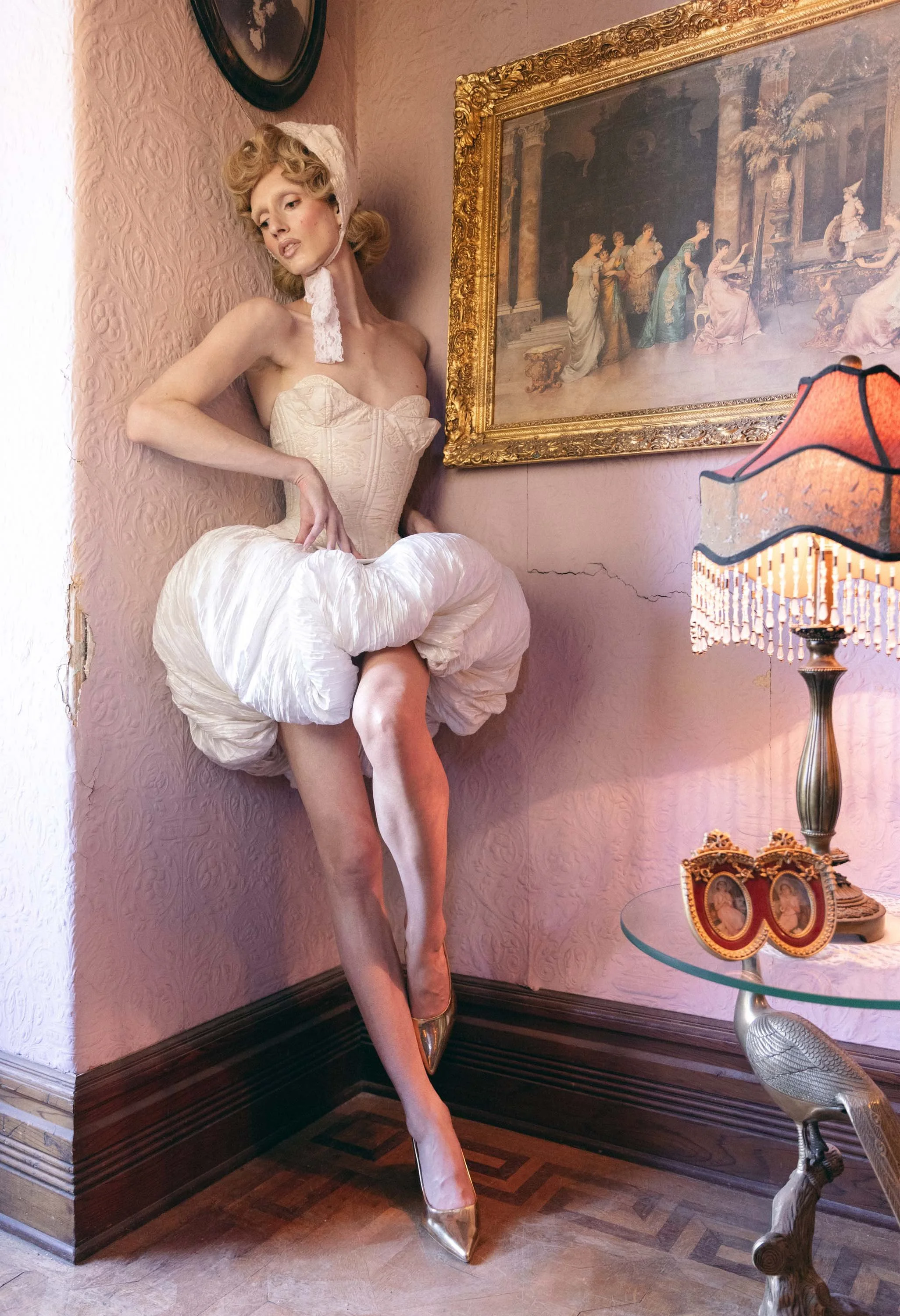
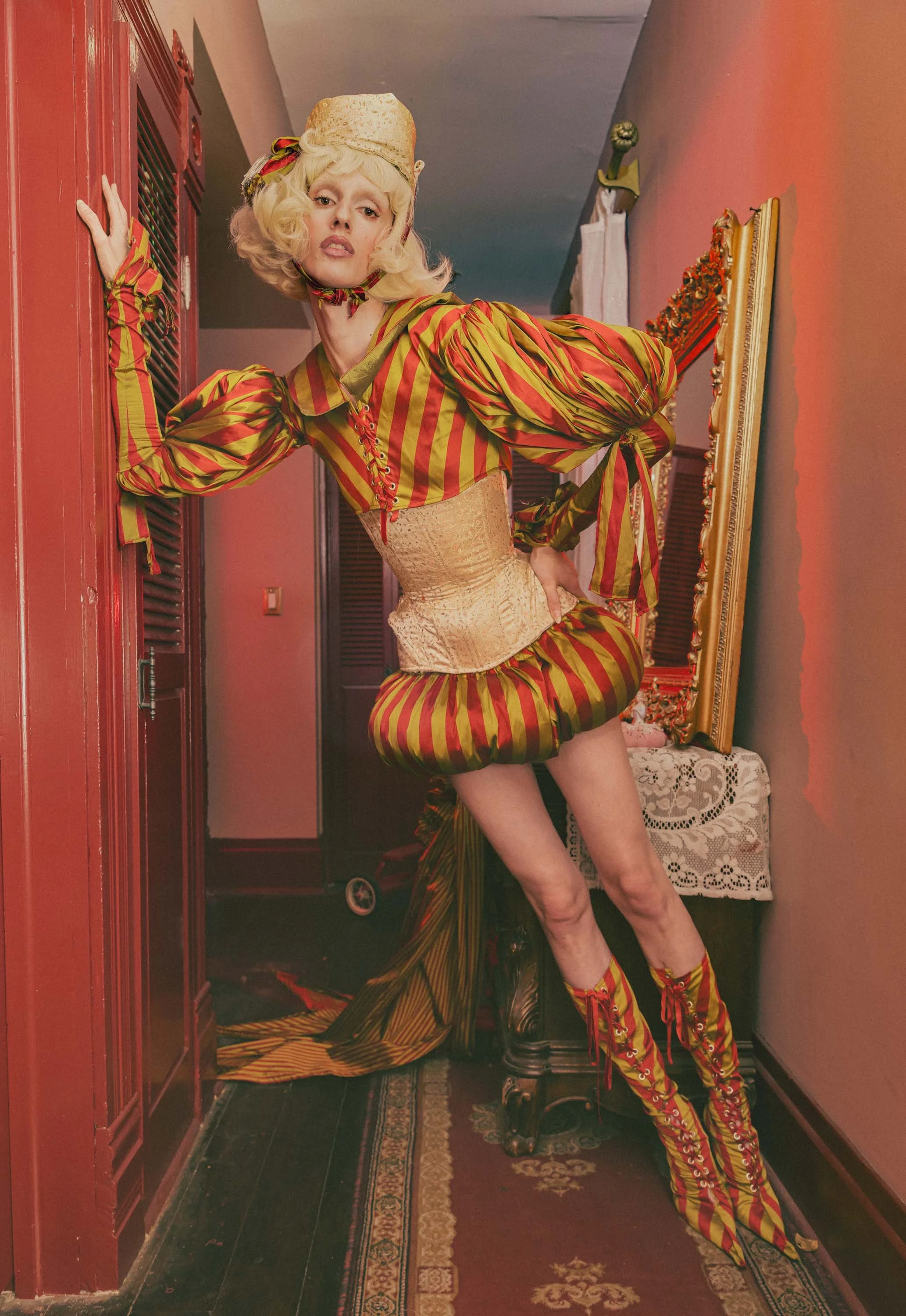
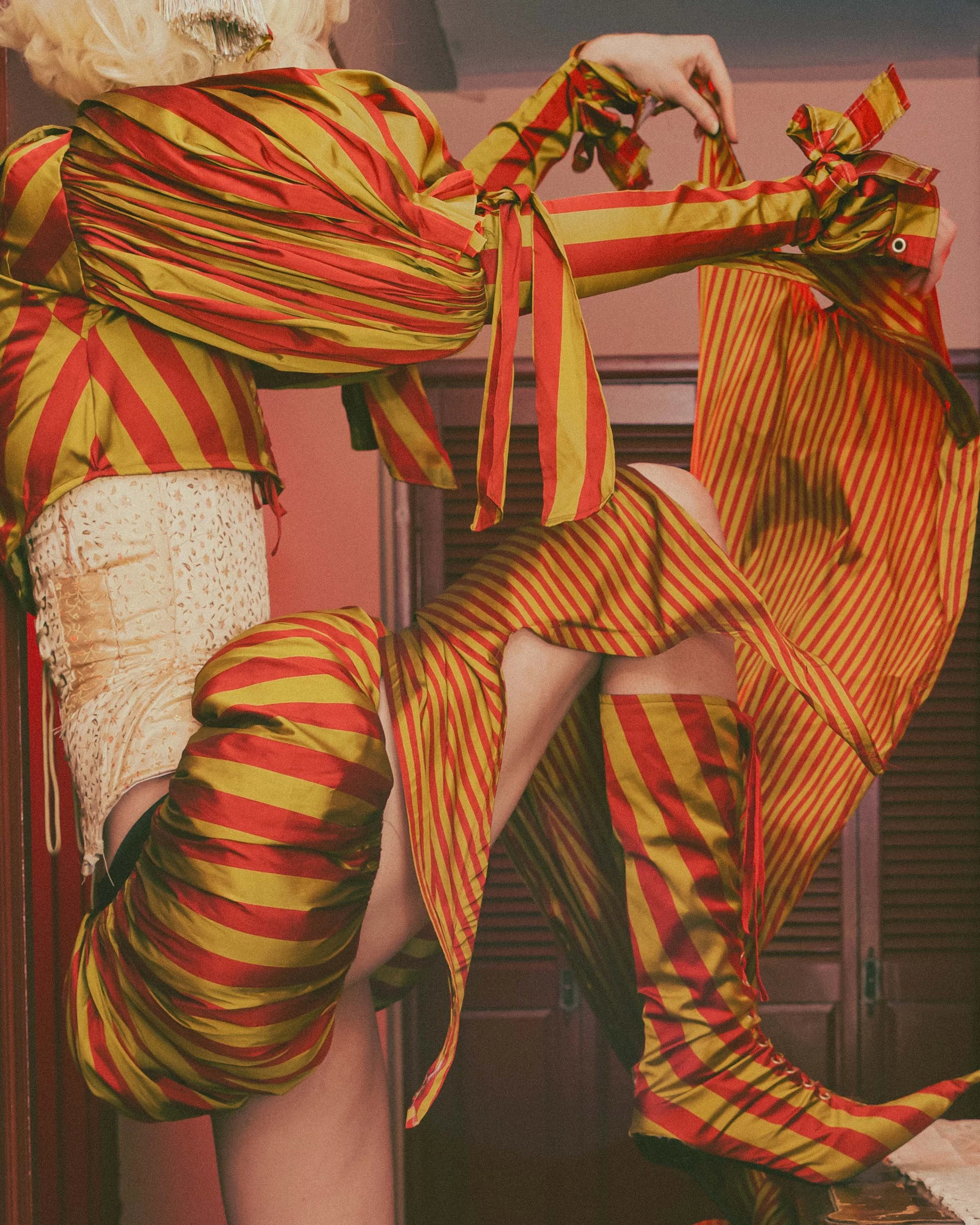
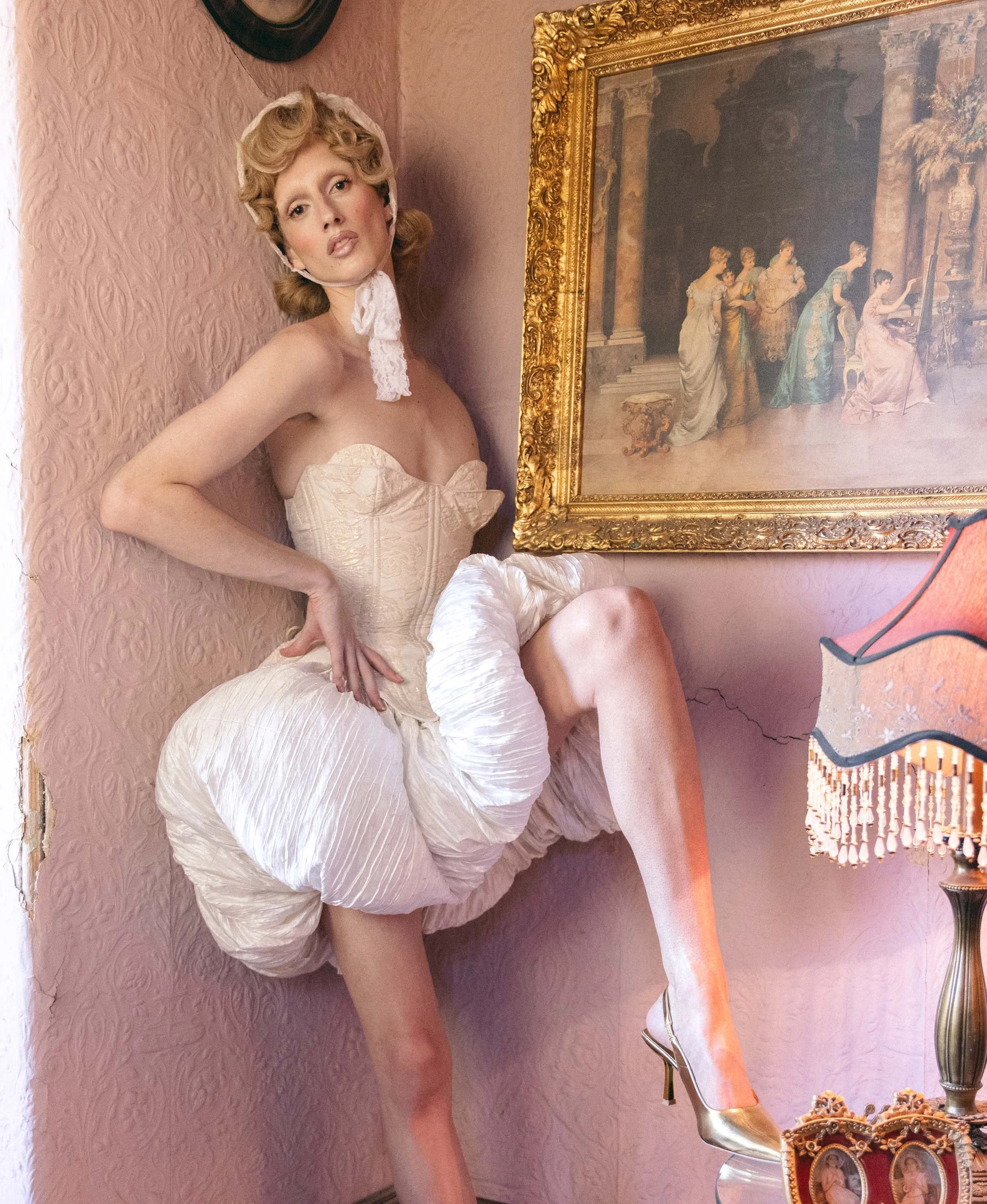
As she puts it: “I think about everything we do to restrict women’s bodies. I want to make sure that my corsets are ridiculous so you're not wearing it to please society, you’re wearing it because it's ridiculous, because it looks cool, because it's exaggerated.”
Her silhouettes reinforce constriction through boned corsetry, and subvert it completely with dramatic bubble hems, what Erik calls her “own version of the conservation of matter.” She’s managed to fabricate a feminine ideal that also feels confrontationally feminist. “I have an equation of playing with negative space,” she explains. “If I’m removing space from the waist, I want to triple it or quadruple it somewhere else.”
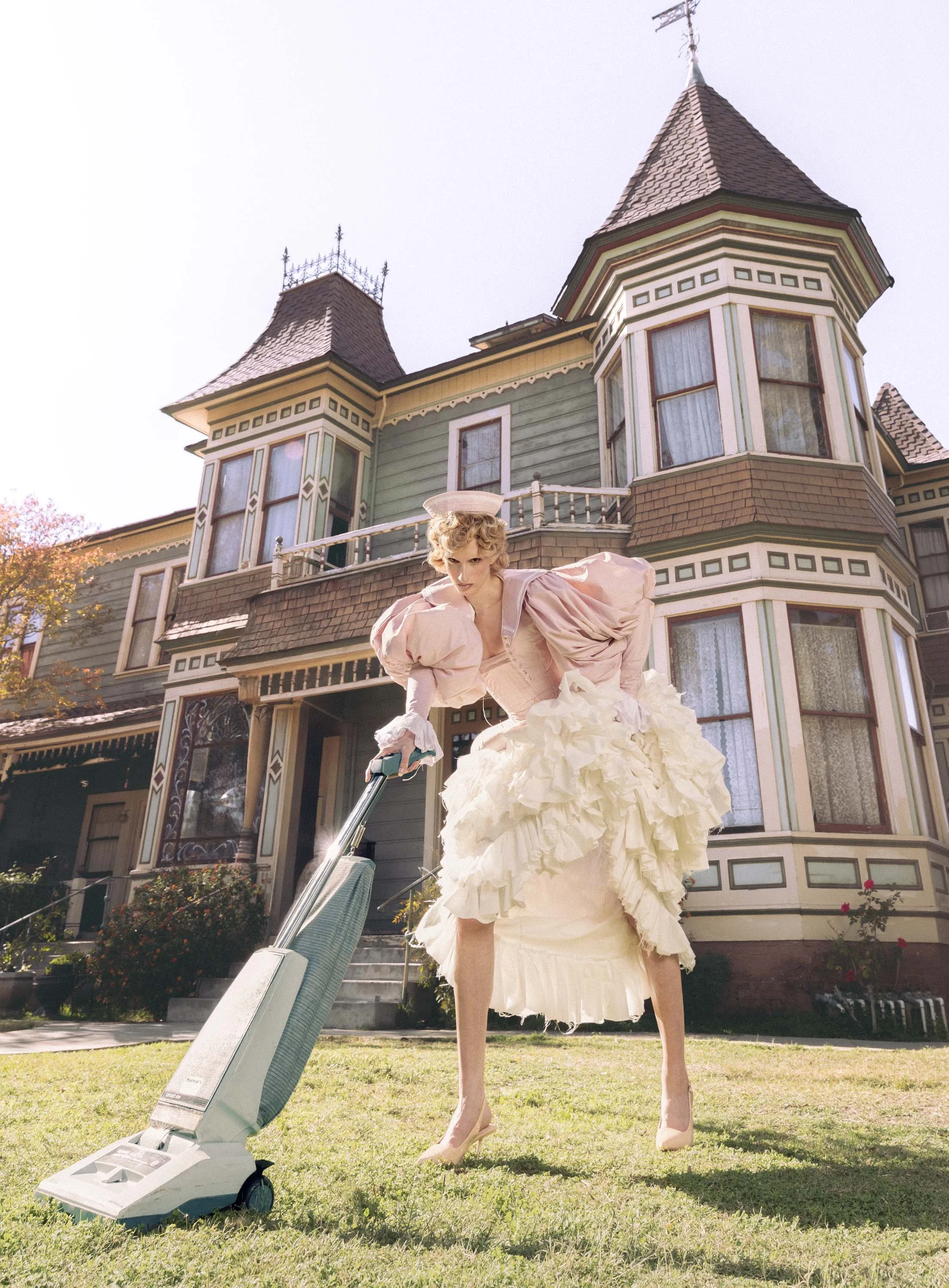
That same balance is integrated in all aspects of her work, where Erik seemingly bends the logic of a single fabric. She often works with men’s suiting material - lightweight and crisp - that she divides into opposing puff sleeves and steel-fortified bodices. “Hiding structure under the surface of something that seems delicate is something I play with a lot,” Erik explains. “Within the same garment you have two completely different pieces made from the same fabric, but if you were to pick them up they’d be totally different.” Her choice of material is both practical and emotional: “I like taking these very male elements and making them as feminine as possible,” she says, letting the fabric itself carry the contradiction. It’s a kind of satirical science: a power suit and a tulle gown walk into a bar.
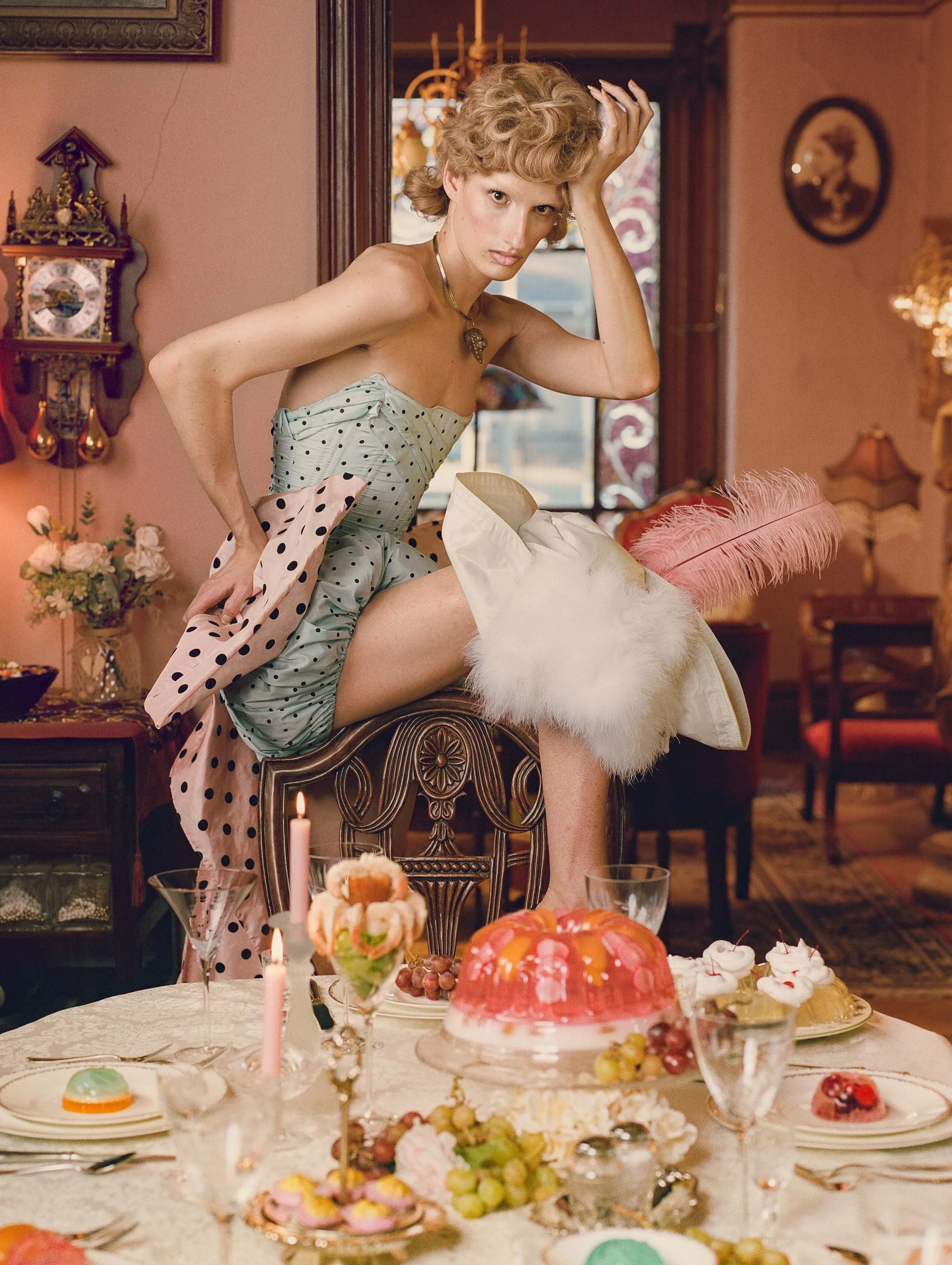
I notice the same duality in Erik’s social media. She builds looks loud enough to headline a runway, then photographs them on an iPhone in her living room. “It does kind of ground it in a way, and makes it feel a little bit more vulnerable and intimate,” Erik tells me. It makes sense that her earliest traction came from these posts; the simplicity doesn't blunt the impact when the work speaks for itself. They read like visual diary entries that translate the fantasy into something tangible, proof that spectacle can survive the landlord special.
Erik’s work embodies that, perhaps, contradiction is an extension of femininity rather than a symptom of our fixation. She makes no attempt to resolve our conflict; her art remains equal parts self-aware and reflective. While that refusal mirrors our willful ignorance, it’s also personal. “I’m really drawn to restriction and freedom within the same medium,” she explains, “which is emblematic of how I grew up, because I grew up religious and Mormon. That’s a really duelling concept with being trans.” Erik adds that growing up in a masculine environment has shaped her experience and her evolving relationship with femininity.
That vantage point, of being read, objectified, and commodified as a trans woman, sits at the core of her upcoming debut collection. “When it comes to that sort of fetishisation, being forced into a box and a label as a trans woman is something I share with my friends so much,” she tells me. “But it’s not a story that’s told very much. I’m trying to tell it in my own way and have it be this through line that can be relatable to any woman but also touches on the trans experience in a really chic way.” Erik’s collection follows a naive spirit that decays into an oversexualised being before a balance is restored between the two, in what she describes as “the experience of having an image forced upon you.” If womanhood is an enduring trauma, then that deliciously subversive ‘chic-ness’ is a right-of-passage.
Femininity has always been a study in contradiction, a choreography of taking up space and shrinking inside it. Erik’s corsetry performs its own reversal: the tighter the lacing, the more the self presses outward. Beyond silhouette, femininity in entirety is a constructed polarity, carpented to feel effortless; poise and grace through wartime, raising a family or a career, loving and losing. Hell, even its sanctity is a contradiction. The female form certainly hasn’t been a temple, but it never needed to be.