
Net Art and How Homemade Websites are Our Last Bastion of Hope Online
Words: Oritsemughone Ogbemi
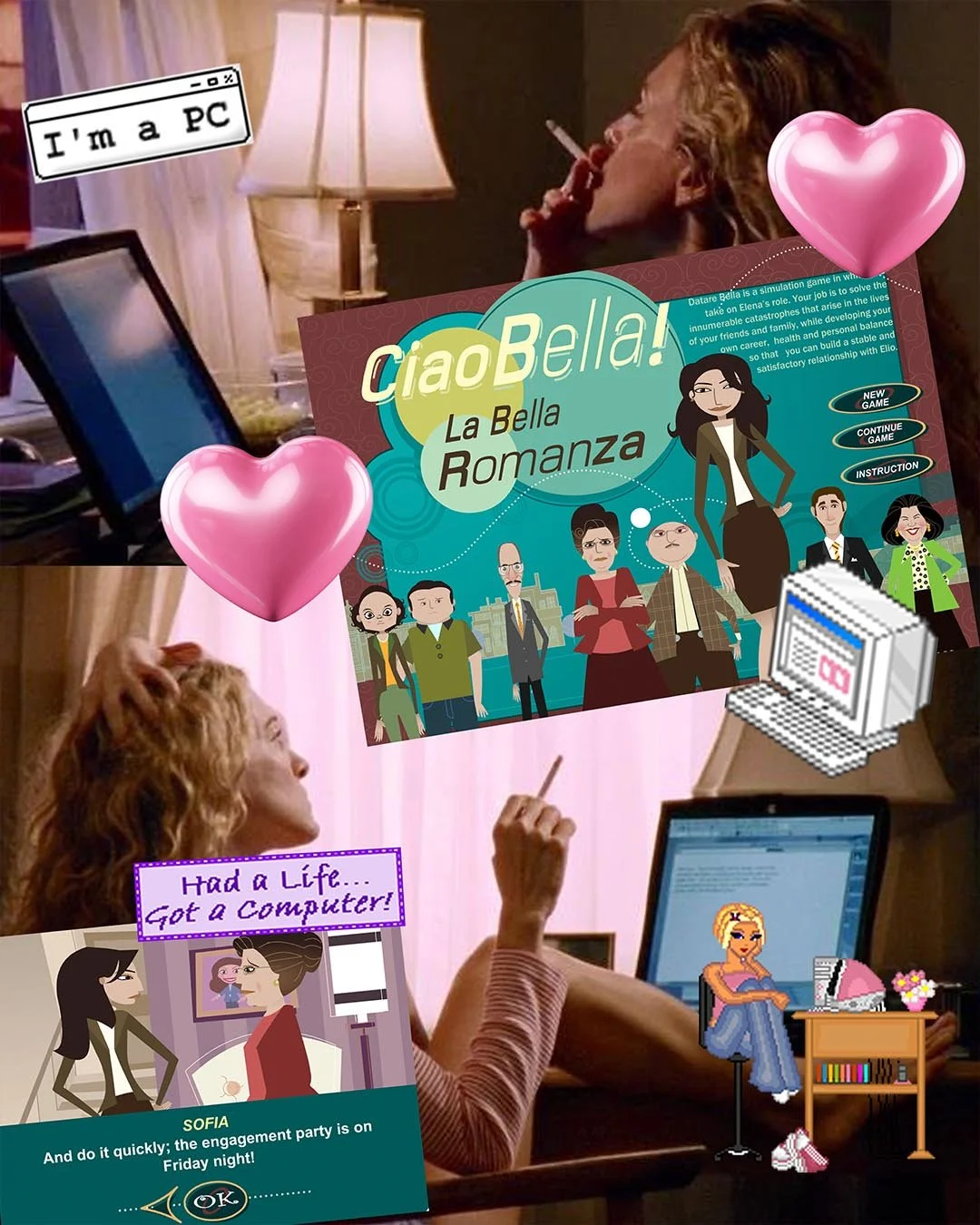
There is an online game that my friends and I used to play as eleven-year-olds called Ciao Bella. In Ciao Bella, you - the user - are an Italian-Canadian woman named Elena who is juggling several responsibilities: her job at her uncle's firm, her relationship with fickle boyfriend Elio, her housekeeping duties, her older sister's unhappiness, and her own health, well-being, and urbanity. The purpose of the game is to respond to each of the demands that city life makes of your character without running out of energy. You win the game when you have successfully maximized 'health,' 'culture,' 'family,' 'work,' and 'harmony' points while keeping Elena's expenses low. It is still playable on the Flash Museum, an archiving project that collects and publishes flash games from the early 2000s through an emulator.
I often think of Ciao Bella when building websites as part of my present work as a front-end developer. When I was a pre-teen, the game was a bewitching way to organise the desirable but anxiety-inducing possibilities of adulthood in my head. I am twenty-seven now and living the superficially hectic life of an Elena, albeit in Lagos, Nigeria and not in Montreal - and because of my age, I now tend to search out very different playgrounds and possibilities on the internet.
But, more importantly, I am able to assess websites, games, and digital culture self-reflexively. It would have been fair to say that in my tween years, Ciao Bella was playing me and not the other way around. Real life is after all not winnable. These days, it feels useful to wonder what imagined realities I am most drawn toward. Which lives do I desire to play through or prototype and why?
Sixteen years have passed since the era of flash games as I experienced it. I set up an Instagram account in 2011, joined the current of social media - though it was less depressing then - and forgot about Ciao Bella. It seemed to me at that time that I was effectively shedding my childhood. Social media was where the adults were. Games were not. By creating a profile, I recreated myself as a grown-up.
___STEADY_PAYWALL___
“ The dilemma that is presented to us by social media seems to me to be: Where do we go after we have finished growing up?”
Make it stand out
Whatever it is, the way you tell your story online can make all the difference.
At that age, I never knew what to post. What sort of caption would a real woman write? On Facebook, I would spend hours poring over that iconic and creepy query: What is your status? Trying to live into my adulthood too early meant that I saw myself as tongue-tied. To admit that an adult woman - an adult me - might not post anything at all was out of the question. She had to post because I, at eleven, wanted to know who she was. Knowing her felt like a question of survival. The dilemma that is presented to us by social media seems to me to be: Where do we go after we have finished growing up?
A number of net artists are exploring their own versions of this problem through web-based experiments. Net art is defined by Rhizome - the digital art affiliate of the New Museum - as "art that acts on the network or is acted on by it." Net art comprises surf clubs, blogs, games, internet poetry, websites, fictional social media personae, and other projects. Many pieces of net art consciously deal with possibility by imagining new Internets - not surprising, considering the way in which we grew up - and one such work is Filipino designer Chia Amisola's website idea generator. Examples of the prompts generated by this strange engine include: 'a website that is ambient' and 'a website made for just one friend.' When 'handmade' - that is, coded by a person using the basic web implements Hypertext Markup Language and CSS - these become very specifically subversive methods for hanging out online, and realising that has given me an idea.
It's easy to feel helpless on the mainstream web, even though we are consistently told by tech oligopolists that anything is possible when we use their tools and platforms. One of the reasons why we feel helpless is that narratives around extinction and obsolescence are forming a much greater share of global discourse with the rise of artificial intelligence. The imperative is usually to get on board or risk total irrelevance, if not social death. The presence of omni-tools and omni-platforms of course expunges the important and often pleasurable work of sourcing or creating your own materials, equipment, and environment for a project - of choosing how you do things.
In small web or handmade web projects, on the other hand, there is usually strong evidence of the way a particular person thinks. Omayeli Arenyeka's simple Afrobeats tool is an example. It lists the most common Nigerian women's names in Afrobeats songs ordered by the frequency of their appearance and requests contributions from users. Then there is Taylor Paydos' spoof quiz, Cybertrophy Mag, which simulates the experience of curating a social media presence that does not cause friction in your offline life and then gives you a quasi-astrological classification based on your choices. Net artist Molly Soda has been archiving the contents of her desktop monthly for the past six years using hotglue.me, and the fascinating output is scrollable here.
These may seem like strange, incongruous examples, but I would argue that they tell a story about what it's like to be on the internet that is curious as opposed to totalising. They build and are a version of the internet where it is still possible to really play.
A project that iterates beautifully on this mission is Amisola's haunting poem/game, flower picking, manila north. flower picking takes the user through a moving album of eerie collages, pop-ups, gifs, and texts, obliquely telling the story of a large cemetery in the north of Manila where impoverished city-dwellers inhabit mausoleums. Amisola is from Manila and works extensively on Philippine history.
There is a depth and roughness to this piece and the others I have mentioned that undermines the smoothness and superficiality of the mainstream web. When they are not about a particular history, they possess histories. They exist on the fringes that are natural to the Internet, where I hope we will soon converge to resist the prospect of our obsolescence.