The Annoyance Economy and the Not-So-Invisible Labour of Chronic Illness
Words: Annie Tressler
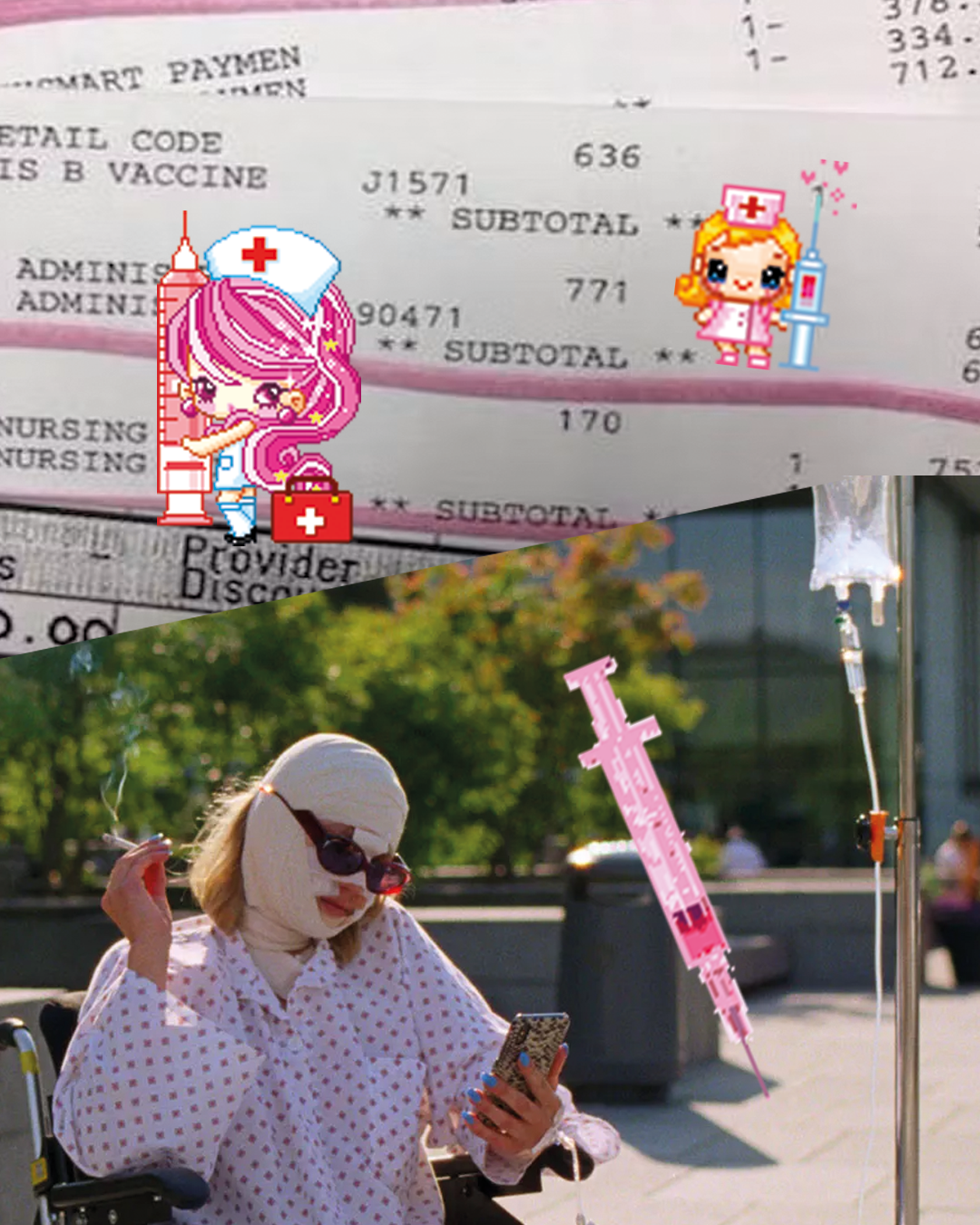
Sometime in the bleak depths of an already bleak February, I received the notice that my health insurance was no longer covering the biologic medication I’d been on for eight years to control the pulsing, writhing beast in my belly known as my digestive system.
I have Crohn’s disease, an autoimmune condition that can debilitate physically and financially. Dealing with the healthcare and insurance bureaucracy has debilitated me spiritually.
And actually, let me clarify – this might take a bit to follow; I didn’t receive a notice – in the typical way of a call or a text, or a letter. It was a MyChart alert from my personal doctor saying that after their own bout of Sisyphean hunting down of records, after their own spate of what I can imagine were exasperating phone calls, messages, and maybe even carrier pigeons, that they found out the medication was, plainly, “denied” and that I would have to try out a “similar” medication. Classic.
If I had a Wikipedia page, it would probably say:
Early life
A relentless war with health insurance
Death
“They define the annoyance economy as ‘what we pay in time, fees, and irritation to navigate our daily lives.’”
___STEADY_PAYWALL___
Thus begins my own goose chase, this journey into a place where normal logic and reality cease to exist. It is shocking, and impressive almost, those hours and hours of asking insurance agents common questions like: what happened? Why wasn’t I told sooner? Why do they believe they can make medical decisions on my and my doctors’ behalf?
Like many chronically ill people in the US, the healthcare system has, at times, rendered me both a full time secretary of my body as well as a completely docile agent.
I, like the other 60% of Americans with a chronic disease, could opine for days about the often harrowing, sometimes absurd, always annoying ways labour shows up when you have a chronic illness, and one “deemed expensive,” at that, like some Chanel purse. We do not get paid for this labour. We are, in fact, the ones paying for it.
That spiritual degradation in the name of bureaucracy and "process" has a name: “the annoyance economy.” In a recent 2026 report, Chad Maisel of The Groundwork Collective and Stanford economist Neale Mahoney, lay out its many contours and consequences. They define the annoyance economy as “what we pay in time, fees, and irritation to navigate our daily lives.” These thorns in our collective side show up as those quotidian timesucks and headaches: the interminable waits on the phone, the dealing with chatbots – these unsouled robots – that steward the customer in a circuitous, hellish route sometimes to nowhere.
The ramifications are stark. Each year the “annoyance economy” costs American families at least $165 billion in wasted time and lost money. So brutal do Americans find shopping for health insurance, they report it worse than getting a cavity filled or sitting in the middle seat on a flight. I thought we Americans loved shopping!
Patient administrative burden breaks down into three streams of labour which patients take on when navigating a chronic illness: learning costs, compliance costs, and psychological costs. Much has been written about this phenomenon, but as most people in the trenches know, it cannot be understood unless lived.
It looks a bit like this: the calls, the headaches, telling work why you need to step out, feeling guilty about said stepping out during work hours.
It is like stripping naked in front of your co-workers, here I am, sick, and taking time off to handle the sickness. I'm sorry I'm sick. I wish I were not sick. The irony is that I must work this job, despite being sick, in order to afford this horrible insurance, to stop being sick.
Reading the fine print of insurance coverage; the loopholes, and regulations, and then making the required phone calls, sending the emails, sending paperwork (yes, paperwork in the year 2026). Fluency in acronyms and copays and deductibles.
It is infuriating to be reduced to an economic decision, a data point mapped by a perverse matrix of risk and reward. Evidence supports that much of the annoyance economy functions by design, making corporations and health insurance companies richer.
It’s akin to a hazing journey. Here’s a body – yours – it requires so much, and it is quite hard to acquire what said body needs.
Learning the labyrinthian system of U.S. healthcare requires an eagle-eyed precision in understanding your rights and benefits – even when the people who are denying or delaying, themselves don’t. I try to be useful to others, to my compatriots who are uninitiated in the art of what I like to call benevolent Karenning, a.k.a. asking, repeatedly, to speak with a manager. I try to offer them my services, to pay back what my friends online have given me. Communing with those who are facing the same challenges, whose nervous systems are being seemingly rewired with each transfer to a billing department and each declaration of 'please hold,' is often the only way to get by.
I sometimes find myself exhausted with myself, with this neediness inside me that shrouds every aspect of my life. But I continue through, on the phone fuming, making small steps toward progress.
By April, I switched insurance plans, which damn near killed me, and received new medication, beginning the process to control the beast within me again. I see the medication commercials on repeat across my television, the ones that promise bright blue skies and explain how this autoimmune disease is like a relentless weed. It’s one I will continue to keep trimming.