
The QVC-ification of Luxury Bag Resale
Words: Cassidy Sollazzo
Make it stand out
For the past two months, tuning into Rebag’s TikTok livestream has become a cornerstone of my morning routine. Sometimes it’s with my coffee, other times it’s before my feet even touch the ground. It’s become a small source of anticipation each morning, or even each night before I go to bed; I drift to sleep thinking about what might be waiting for me on Rebag tomorrow.
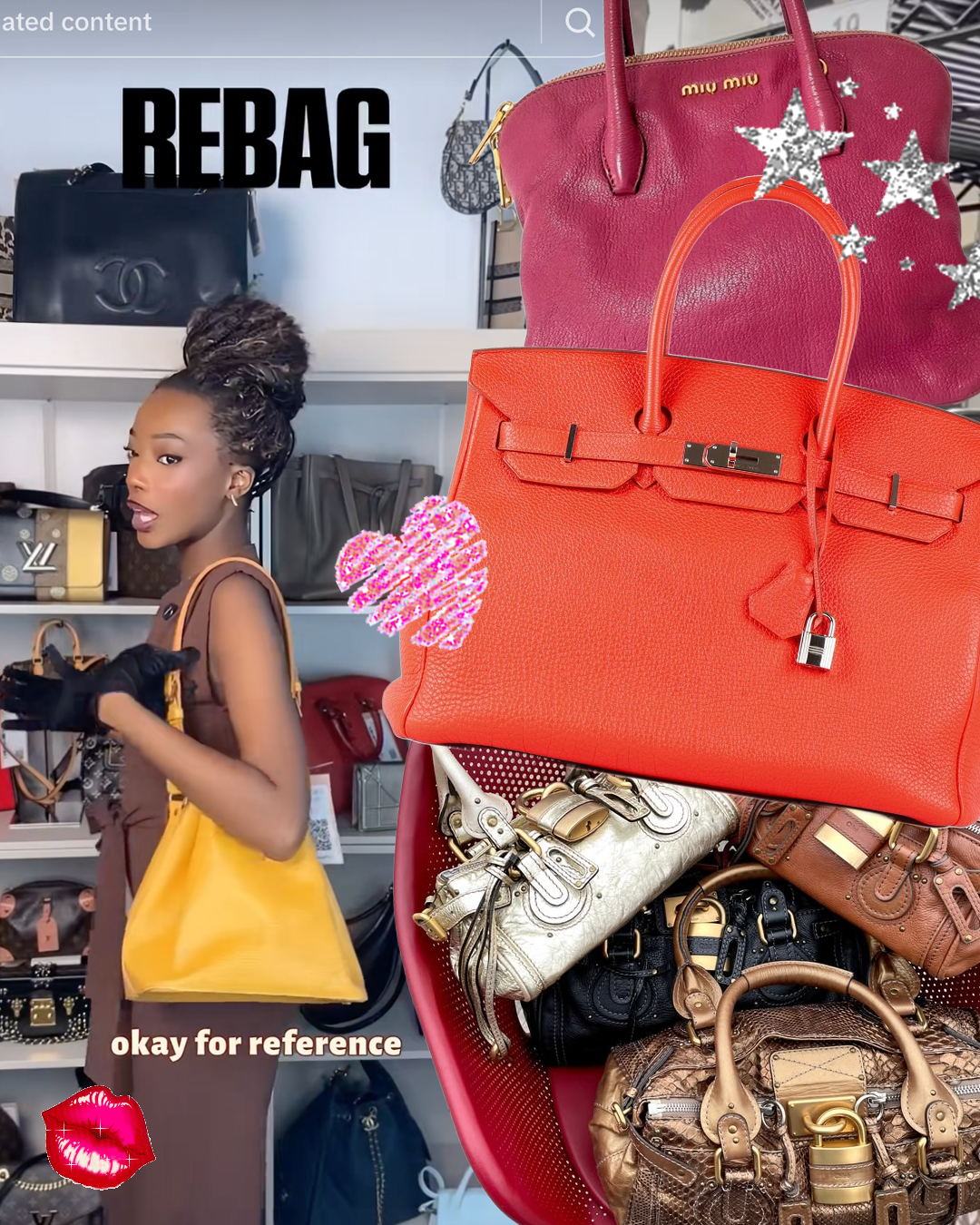
Let’s backtrack a little. For the uninitiated, Rebag is a luxury resale platform that hosts TikTok livestreams seven days a week, 12 hours a day (ten on weekends). By 8 am sharp, one of their handful of hosts, often dressed in chic neutrals, stands in front of a ring light with shelves of designer bags behind her, rattling off everything about everything about bags.
@user19233293 asks her to show a mini Gucci Jackie 1961 in mustard yellow. “Of course! A stunning choice; you have a good eye,” the host says, smiling as she models the bag, shows close-ups of the exterior, and flashes the interior. “Do you like the size? It’s on for $1245, but we can drop the price to $1050. But only on this live.” @user19233293 comments “DROP,” and the host rings a bell to set a timer for the flash deal. They - or anyone else tuning in who is feeling impulsive - can add the bag to their cart and purchase without even leaving the TikTok app.
Boutiques and resellers like Rebag andReunited Luxury spend hours presenting pre-owned Chanel flaps, Fendi baguettes and Dior saddles to their audiences via livestream every day. The live is built on requests: a gold shopping cart in the bottom left corner of the screen pulls up a list of the current bags on offer. It’s not their full inventory; it’s never their full inventory, and they make sure you know that. Viewers can click “ask to show” on any item, which sends a notification to the host, who then brings the bag out and shows any and all specifics, answering questions, comparing models, and offering up livestream-only price reductions.
I rarely, if ever, buy. But I do ask to see things. I also ask for them to show closer details. I have almost pulled the trigger. It’s tempting! The stream feels like entertainment and routine as much as shopping or browsing, with the “ya never know” ethos giving me a reason to check back in every morning. ___STEADY_PAYWALL___
The format is akin to QVC for the gen z, chronically online, luxury influencers of the Now.TikTok Live Shopping has revived the decades-old logic of QVC for the luxury resale market, while making it more personalised, habitual, and socially immersive. By letting shoppers examine one-off bags in motion, communicate directly with hosts, and negotiate, bid, or unlock temporary discounts, these streams turn the uncertainty of secondhand shopping into a mix of trusted routine, communal entertainment, and impulse-driven pseudo-competition.
QVC and HSN established the formula that many of these livestreams still abide by: rotating products, charismatic hosts, limited quantities, try-ons and demonstrations, urgency. Founded in 1986, QVC churned out billions of dollars in revenue at its peaks, its 24/7 broadcasts and low prices making it the biggest and most popular of the home shopping channels. Celebrity guest hosts have included Lisa Rinna, 50 Cent, Martha Stewart, and Kris Jenner. But the last decade has proven challenging. After a pandemic-induced boost in 2020 (surpassing $14 billion in revenue), the migration away from cable hurt the home-shopping giants (according to the New York Times’ Dealbook, QVC and HSN were in 45% fewer homes in 2025 than they were in 2018, and they filed for Chapter 11 bankruptcy in April).
“TikTok has made QVC’s shopertainment formula even more intimate and enticing. At the same time, it is arguable that it also breeds thoughtless consumerism and overconsumption by being even more at your fingertips than Amazon.”
Live shopping on social media, in general, has become an increasingly lucrative way to make money, both on TikTok and other platforms. And this is true for anything, not just the luxury bag market. In March, MAC announced that they would offer commission to any of their UK staff who sell products on TikTok live. And last December, Kim Kardashian’s Skims livestream garnered 30,000 views, signaling a long-awaited increased appetite for live shopping from US audiences.
The livestream ecosystem is steep, with some functioning as an extension of a brick-and-mortar (or online) store, or as a primary means of sale. Rebag, for example, has an online site, a few physical locations, and a seven days/week livestream. The live becomes a destination because of the rotating inventory and in-the-moment discounts. Yet for a place like Reunited Luxury, which has a dedicated storefront in Vegas (and some airport pop-ups?), if you want to shop online, the only way to do so is via livestream. 17th St Vintage in New York City has an IRL store in Union Square, but operates a separate livestream shopping component. There are also countless independent sellers presenting their inventory directly through TikTok, doing the same thing on a smaller scale.
The longer I watch the lives, the more I understand the appeal, especially for buying a luxury bag, and especially shopping online. It seems counterintuitive, or like a recipe for scammery, but it’s surprisingly effective in practice. Bags have different conditions and history, and color and wear can be difficult to judge through photos alone. Livestreaming allows viewers to see the bags in motion, beyond whatever set photos exist online. It makes the transaction feel more personalised than QVC, and more tactile than conventional e-commerce. And now, when I browse The RealReal, I’m left wishing I could see a bag from a different angle, or ask the seller to model it in a different way.
These livestreams are also changing the atmosphere traditionally associated with designer shopping, replacing the polish of the luxury boutique with accessibility mixed with parasociality and relentless momentum. It’s more casual, viewers having more control over what they see. It’s a particularly effective combination of active and passive shopping; even viewers who never buy anything (ahem, me) can tune in to watch strangers claim bags. Luxury consumption becomes communal entertainment, with the reseller serving as a hybrid salesperson, authenticator, stylist, and performer.
Repeated viewing breeds familiarity, which in turn breeds trust, which then increases the potential for impulse purchases. Viewers come to recognise the hosts, and in turn, hosts even recognise the viewers (“Hi Jaclyn! I remember you bought our Speedy 25 last month, how are you liking it?”). While the hosts are obviously doing a job and their goal is to make sales, the format is intrinsically more personal. And sometimes, it’s even easier to say no to a big purchase via the comments section as opposed to in person. When someone on Reddit asked for takes on where to buy pre-loved designer, u/spagetti111 offered up their POV: “This is gonna sound questionable, but I have purchased two bags in lovely condition (and at great prices) from a woman who sells on TikTok lives… I trust her and she is super nice and responsive. She has also said in the past that she can source specific bags her customers are looking for if you DM her.”
Still, there is tension at the heart of this format, a built-in sense of urgency to purchase something, even if the hosts themselves aren’t being obvious about it. On Rebag, specifically, they remind viewers that this is their “chance” to snatch these deals, because the bag isn’t guaranteed to be around for long, or to even be on the stream tomorrow. Dropping prices on the live also turns the streams into a need-to-be destination; there’s an incentive to buy live, discouraging casual browsing on your own time. The timer, too, when they drop the prices: Viewers often get two minutes to make the purchase, the format prompting them to act on the trust that comes from repeated viewing.
Designer bags themselves retain their exclusivity simply because of the prices, but the experience of browsing becomes unusually accessible on a TikTok Livestream. Anyone can enter the stream, ask questions, or watch for hours without crossing the intimidating threshold of some luxury boutiques. TikTok has made QVC’s shopertainment formula even more intimate and enticing. At the same time, it is arguable that it also breeds thoughtless consumerism and overconsumption by being even more at your fingertips than Amazon. It sucks you in and gives you tunnel vision, not unlike going into a casino and forgetting what time it is. If I tune into a stream for too long, I definitely get the feeling like I need to go touch some grass. But whether or not I buy anything today, I'll probably check again tomorrow morning. And the morning after that. You just never know what the stream will hold.