Words: Harriet Morris
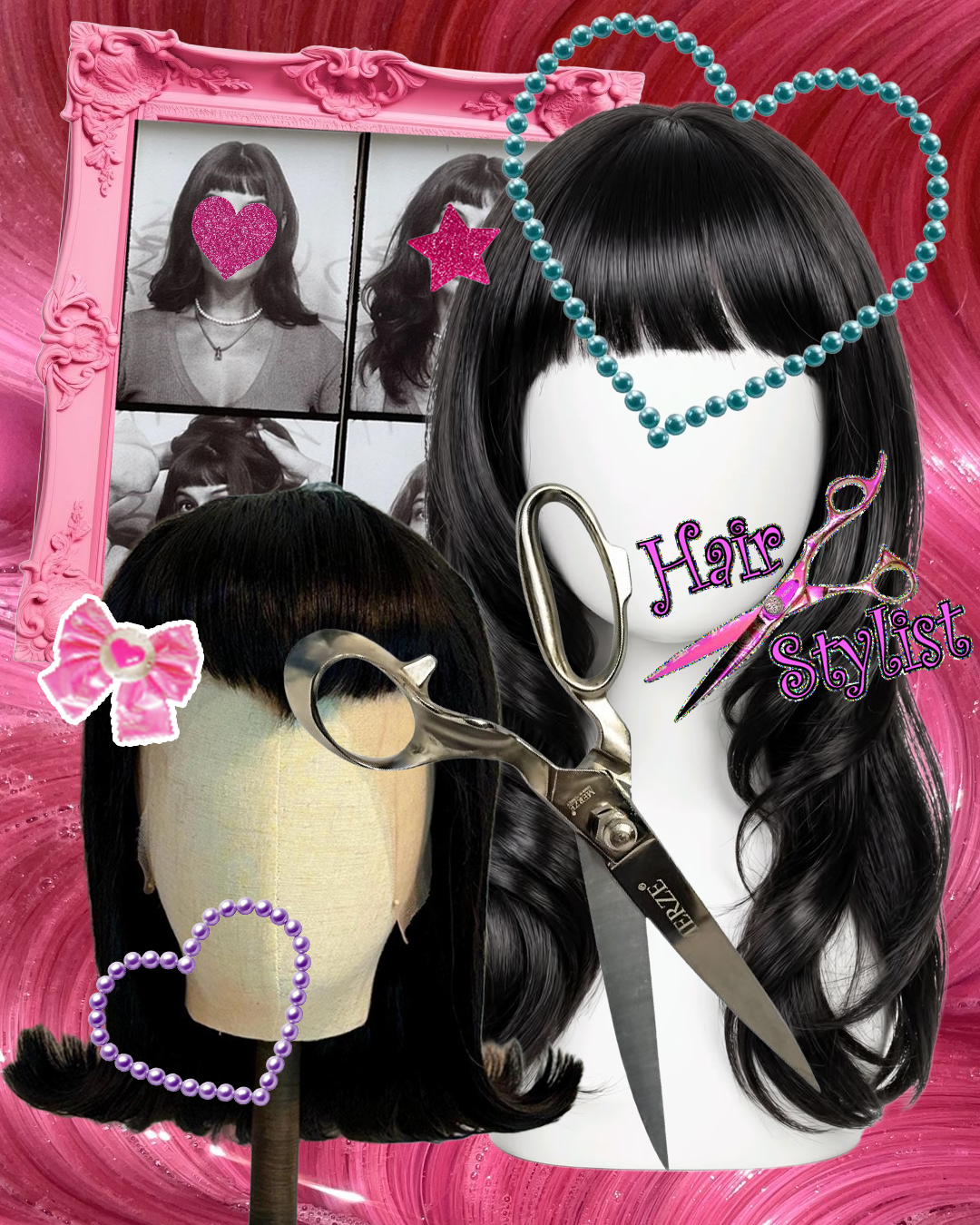
An Instagram Reel with 1.5M views opens to a woman staring determinedly into the camera. She has bangs of the standard variety - not baby or micro, or, a term I learnt recently: ‘fetus’. The rest of her honey-brown hair falls to her waist looking like it would be soft to touch.
A grungy track titled ‘Angel’ plays while she sections her bangs with creaseless clips. Then, taking a pair of scissors, she expertly snips away until the bangs have reached ‘baby’ territory, sitting a centimetre higher than where they began. Now they frame a pair of perfect eyebrows, striking blue eyes and pouting lips, a combination described in the comments as “LETHAL face card omg”. The text overlay reads: ‘the boys are in the dms that means it’s time to refresh the boy repellent (trim my baby bangs)’. The boys are in the comments too, asking “is the repellent in the room with us?”
In another reel with an equally staggering number of views, we see a close-up of a very short fringe as a stylist artfully trims until only a few centimetres of it are left. The overlaid text reads: “men hate bangs”. The camera pans out to reveal a young, slim, able-bodied woman with radiant skin and flawless ‘natural’ make-up. Around the bangs her hair cascades long and lustrous, and as the music crescendos the last words appear: “okay good”. To which someone has rebutted: “No they don’t. I don’t know why this take keeps getting pushed.” Why indeed? Lately, my feed has been a sea of baby bangs content: there’s tutorials on how to cut, style, wash and dry them, which clips to use, what products to apply. And: how to repel men with them. ___STEADY_PAYWALL___
“If men hate bangs, we are momentarily liberated from the performance of beauty for the male gaze while never truly departing from it. This kind of content affirms a dirty secret we wish were true: that you can strive to be conventionally hot and also a feminist.”
Increasingly, the women doing the “repelling” are also the epitome of the modern beauty standard, their bangs as powerless at warding off men as Cindy Crawford's beauty mark. This contradiction makes for soaring views and roiling comment sections, supplying the perfect fodder for Instagram’s mercurial algorithm. Something about a conventionally attractive woman putting one toe out of line (or one small section of hair, as the case may be) engenders bemusement, rage, and adoration in equal measure. So, if, when paired with a genetically perfect and rigorously maintained face and body, baby bangs appear (mostly) futile at repelling men, on which women do they grant this power?
It turns out short bangs or micro fringes have been worn to repellent effect as early as the 18th century. In her essay "The slutty history of the micro fringe", Rosie Harte describes how women who adopted this hairstyle - dubbed ‘the lunatic fringe’ - were presumed to lead unsavoury lifestyles, unconcerned with the propriety of the time.
She writes: “Such deliberate self-fashioning aligned closely with what the Victorians termed ‘fast’ behaviour. A fast woman was one of dubious moral character, accused of idolising vanity, material wealth, and personal pleasure over her prescribed duties as a wife and mother.” Harte notes that the mood grew so hostile toward the hair style that having one could hinder a woman’s employment prospects.
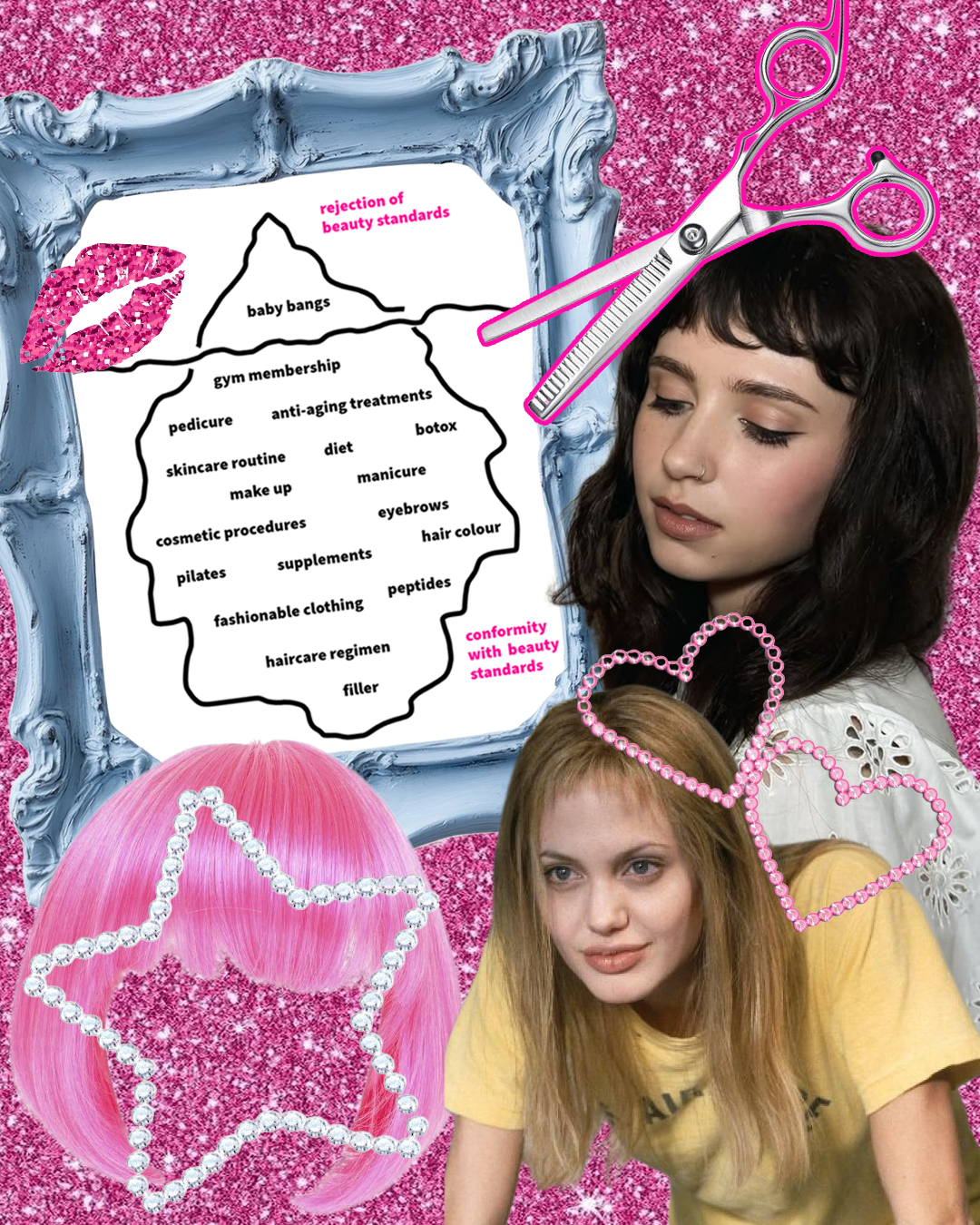
While no longer a barrier to the job market, micro fringes have remained a staple of alt aesthetics, joining blue hair and septum piercings as cultural shorthand for progressive, anti-establishment values. Baby bangs were worn by members of the 1990s Riot Grrrl movement, who popularised a style of ‘infantilised hair’, subverting the tropes of girlhood to highlight the degradation of girls in society. One of the most enshrined pop-culture micro fringes belongs to Lisa Rowe, the charismatic sociopath played by Angelina Jolie in the 1999 cult classic Girl, Interrupted. Most of the female characters in the film, which is set in a women’s psychiatric hospital, wear some variation of bangs, referencing the hairstyle’s early associations with mental instability.
Clearly the micro fringe has lived many lives, a lot of them riotous and unruly, but the question remains RE: this more recent allegation: their capacity to repel men. My sleuthing took me back to 2025, to a TikTok posted by stan account @drewandenyaslover. In it, Enya Umanzor, described by a fan as ‘our misandrist queen’, proclaims: “men have just been looking at me recently, and I’m like ho, how bout this, I’m about to get some baby bangs so you know not to fucking look at me”. The sound was then used by hundreds of women, lip syncing from beneath freshly cut bangs and sticking it to the male gaze. Two months later, creator and self-described grotty girl May Rickets posted a TikTok echoing the sentiment: “making sure my feminist bangs are short enough that men stay far enough away from me”. At time of writing it has 4.7M views and nearly 13K comments, many of them from men accusing Rickets of misandry.
Fast forward to May 2026 and a similarly viral TikTok from New York-based model Aly Kima, who twirls around under the banner “men hate bangs”. Despite similar view counts and the same “misandrist” message, Rickets’ video provoked roughly ten times as many comments as Kima’s (one comment per 364 views versus one per 3,600). Kima’s performance of “misandry” is palatable because, bangs aside (and one could argue hers are closer to curtain territory), her appearance, like that of her Instagram successors, fits squarely within the beauty standard we’re accustomed to. From Rickets’ truly transgressive affront to beauty norms, is it any surprise we ended up with the feminism-lite edition? If anything, this minor “transgression” from a conventionally attractive woman becomes even more charming, a playful rebuke with no real deviation from the status quo.
The more likely scenario is that we love men to hate bangs. If men hate bangs, we are momentarily liberated from the performance of beauty for the male gaze while never truly departing from it. This kind of content affirms a dirty secret we wish were true: that you can strive to be conventionally hot and also a feminist. We can watch a video about “men-repelling bangs” and tick a feminist box before we scroll on to purchase the latest Korean skincare or a supplement that prevents cortisol face. And people will say “just let the girls have nice things,” “let us have make-up and cute clothes and Botox and men-repelling bangs.” Often, I am one of them. But at this point we can no longer see the forest for the trees. If we could, we might realise we’re no longer in a forest at all, but a relentless machine, cold and exacting, whose sole purpose is to make us hate how we look and sell us the solution. And, surprise, surprise, it’s not men-repelling bangs.