
An Ode to the Horse Girl
Words: Isobel Slocombe
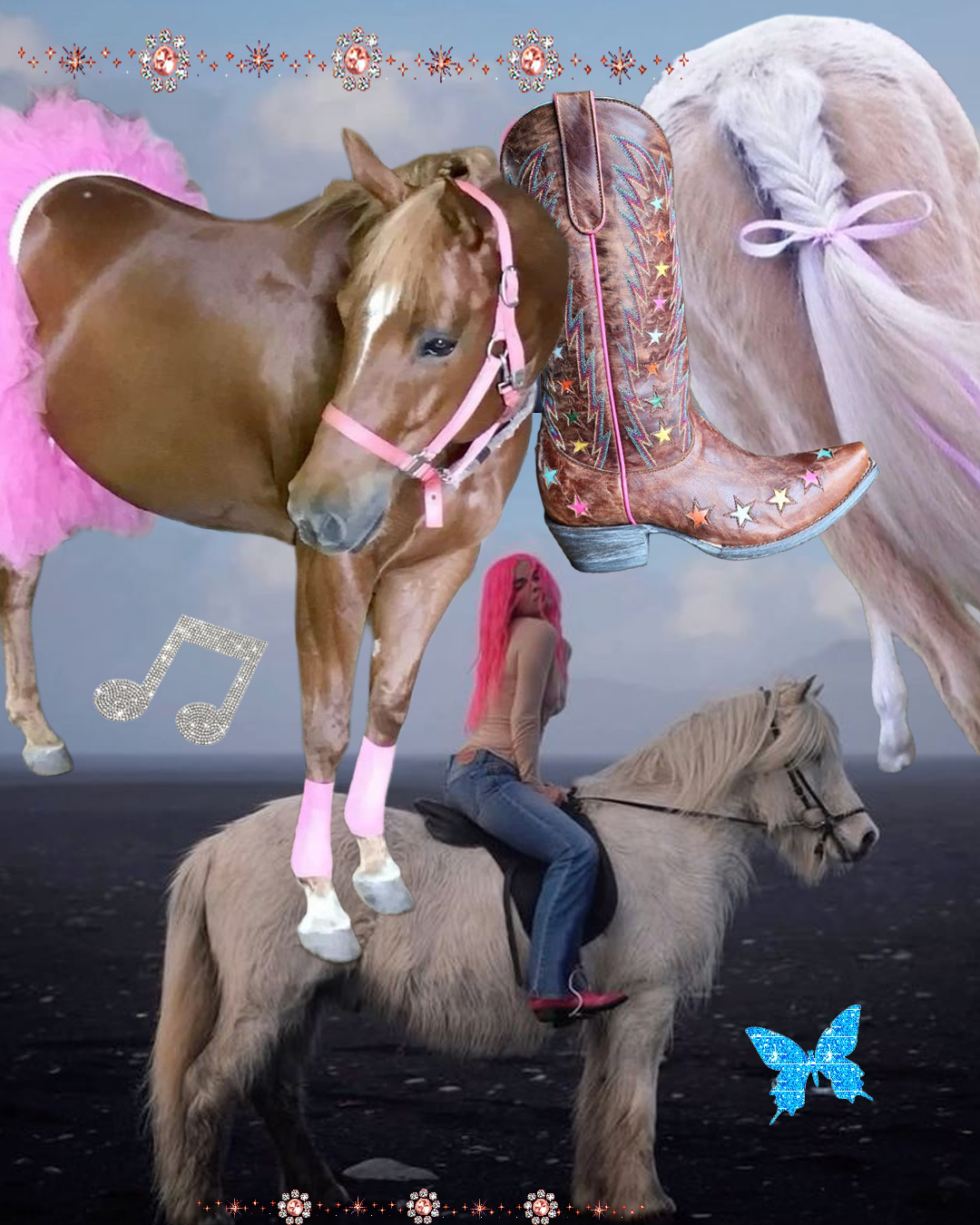
Growing up, my family played ‘Horse-Opoly’ instead of Monopoly. The Shetland pony in place of Old Kent Road; the Thoroughbred, Piccadilly. Before you start imagining some sort of Boden catalogue, all Barbour jackets and Pimm’s on the lawn, I’m not of Etonian, horsey lineage. It was my game, because I was obsessed with horses. A horse girl, if you will. I didn’t own a pony, though I did attach a wooden hobby horse to one of the kitchen chairs and made stirrups out of dressing gown cords. Slightly offputting.
The term horse girl typically conjures images of a gangly, intense, buck-toothed tween. Governed by an unshakeable conviction that she is, in some spiritual sense, half horse herself. She is the girl who neighs in the corridor, who draws manes and tails in the margins of her exercise books, and who can recite the breeds, colours and markings of every pony she has ever encountered in person or print. Hers is a domestic, interior world of fierce devotion, largely indifferent to whether anyone else finds it odd. ___STEADY_PAYWALL___
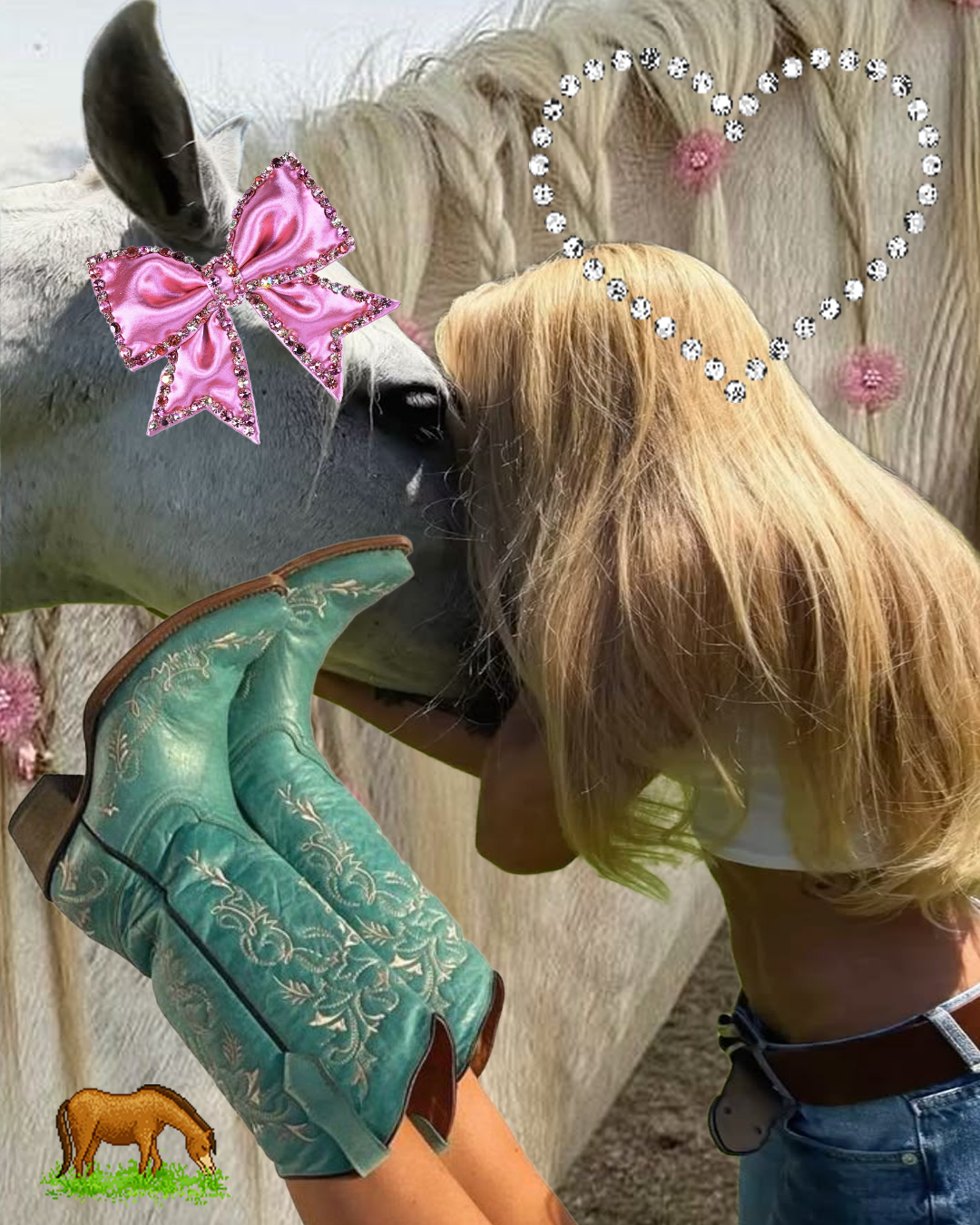
This archetype was largely forged by classic children's literature starring horses, starting with Anna Sewell’s Black Beauty in 1877 and later sustained by 20th-century pony books and series like The Saddle Club like 1988. These stories worked to cement an idealised vision of the horse-and-girl relationship. In their pages, the horse was a confidant, a protector, and a soulmate who understood its young rider better than any peer could. Black Beauty framed horses as sentient beings capable of suffering and loyalty, inviting readers to feel their joys and injustices as their own, while The Saddle Club provided the horse girl identity through depictions of the lifestyle, with early-morning mucking out, weekend lessons, gymkhanas and ribbons. In these books, girls were active protagonists. Braving weather, managing huge animals, and existing in nature without needing a romance or a male hero to drive the plot.
“‘Horse girl’ shifted to police an entire category of unselfconscious, unfashionable behaviour, signaling that female enthusiasm is something embarrassing to be outgrown as quickly as possible.”
Yet once a type is legible, it can be mocked. What the books had initially celebrated as passion, the playground recast as peculiarity. The intensity of the horse girl became a liability at the age when young girls are expected to pivot toward performative quietness and peer approval.
Jean Halley in Horse Crazy: Girls and the Lives of Horses (2019), argues that for young girls, loving a horse is a rare space where they can experience raw physical power, agency, and spatial freedom without appealing to male approval. In a society that conditions young girls to be small and restrained, riding an enormous animal offers a transcendent sense of control and embodiment. Renold and Ivinson go further in ‘Horse-Girl Assemblages: Towards a Post-Human Cartography of Girls’ Desire’ (2014), examining how the relationship between a girl and a horse complicates traditional ideas of heterosexual development. They describe the equestrian bond as an ‘affective assemblage’, a form of connection based on care, physical power and escape from traditional gender roles. Read through this analysis, the obsession isn’t just about ponies. It could be the first time many girls feel big, or part of a club.
Which may be why the identity is so gleefully mocked. The playground insult transcended its roots and expanded to label any girl who was slightly too passionate about anything. Notice how rarely young boys are shamed for equivalent intensity. A boy obsessed with football, trains, or dinosaurs is viewed as studious, enthusiastic, or simply being a boy. But female intensity is treated as inherently unsettling: The horses fell away, and what remained was the sting of the accusation - you care too much, and you are not quiet about it.
A girl obsessed with any niche hobby could find herself branded with the same name, the implication that her enthusiasm was embarrassing and childish. ‘Horse girl’ shifted to police an entire category of unselfconscious, unfashionable behaviour, signaling that female enthusiasm is something embarrassing to be outgrown as quickly as possible.
Yet, in the last few years, the horse has undergone somewhat of a cultural rebrand. We are in the midst of a Fire Horse Year, as TikTok has refused to let us forget, infinite FYP footage of wild mares galloping across beaches with pink pastel text overlays promising “this is going to be your year, girl”. Clips from Addison Rae’s ‘Headphones On’ music video repeatedly circulate. And for his New York Fashion Week debut, Conner Ives sent a horse’s head down the runway on a pleated purple tank, while equestrian-core, riding boots, Western belts, and tailored leather, continue to flood high-street rails. What was once a social liability is now an aesthetic, something to be styled, posted and sold.
This aesthetic rebrand, for me, warrants both suspicion and scrutiny. On one hand, the elevated, neon-lit rebirth of the horse girl is tempting to celebrate. The awkward girls who were mocked on the playground appear vindicated, elevated to the height of cool by fashion editors and influencers alike. On the other hand, the horse has arrived in its most sanitised, hyper-capitalised form. The mares galloping across beach feeds are glossy and wild in a carefully controlled, cinematic way. Real horse care is, at its core, messy, grueling, and unglamorous. It involves freezing hands, mud, heavy manual labour, manure, and physical risk. What the modern algorithm sells back to us is merely the visual shell of freedom. Brazen, romanticised femininity without any of the awkwardness, sweat, dirt or injury that actually defined it.
Which is why I remain wary of the neat narrative in which the ‘horse girl’ finally wins. Enthusiasm that cannot be turned into aesthetic content, that has no built-in audience, and that asks for no public approval remains the hardest kind of passion to defend. It is the raw, un-curated desire that Halley describes. A passion that required no male approval on the playground, and requires none from the algorithm today. The original horse girl was powerful because she was entirely untamed by the gaze of anyone else.