Words: Jenn Lehwald
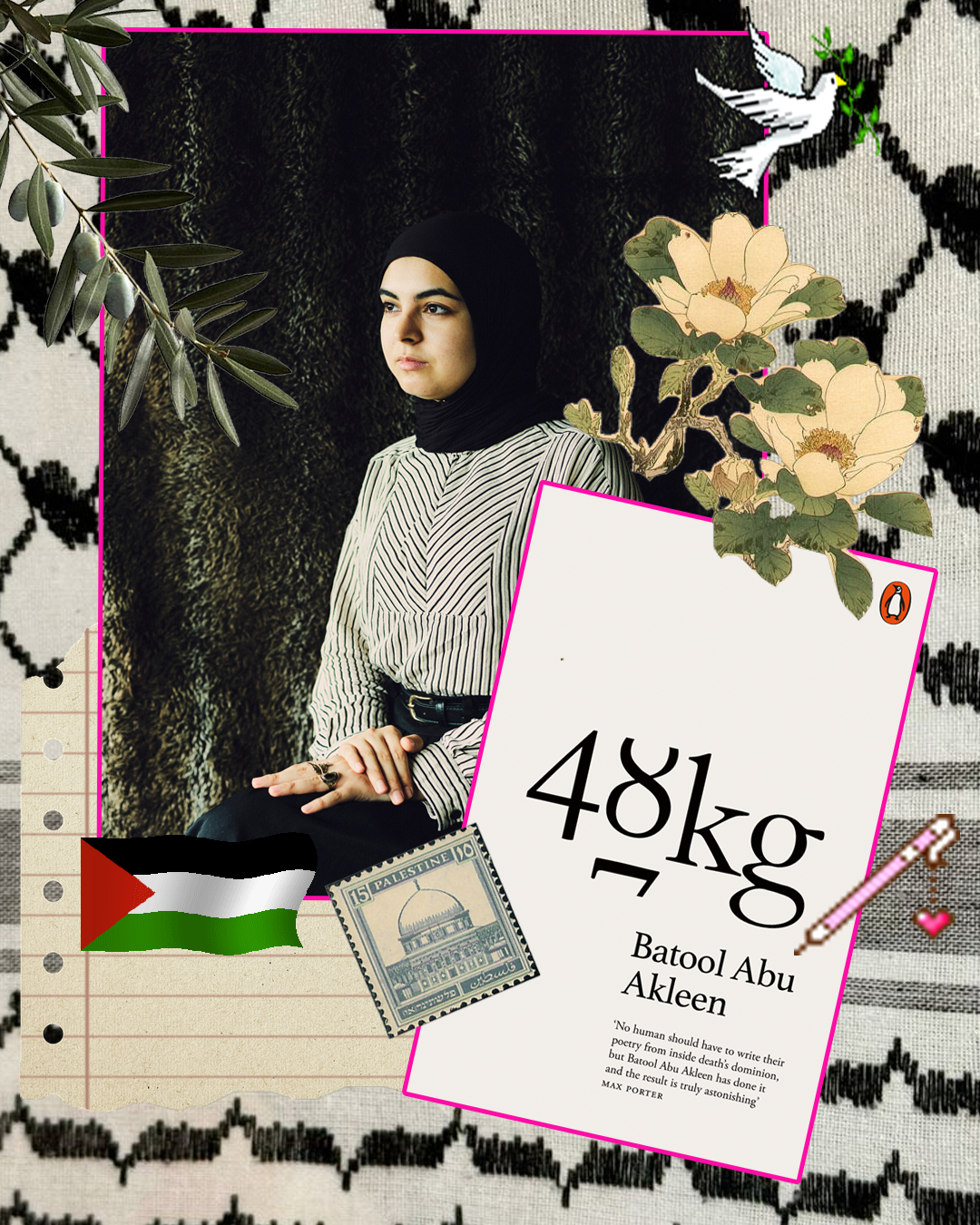
Batool Abu Akleen has always used writing as a way to make sense of the world around her. A Palestinian poet and translator from Gaza City, Abu Akleen began writing poetry at the age of ten, going on to win the Barjeel Poetry Prize at fifteen. Her debut collection, 48KG, published by Tenement Press in 2025, is composed of 48 poems, each representing a kilogram of her own body weight, counting down towards zero. The collection moves between grief, friendship, intimacy and the desire to be seen as an individual beyond the circumstances of her birthplace.
We spoke to Abu Akleen about the process of writing 48KG, finding new language and perspectives via living in Paris, learning to live alongside grief and the friendships and creative communities that continue to make imagining a brighter future possible.
Can you start by introducing yourself to the Polyester audience and talking us through your new body of work, 48KG? How did the collection come together, and what does it mean to you to share it with readers?
I’m Batool, a Palestinian muslim woman who loves playing with sounds. My debut poetry collection 48kg was out in 2025 by Tenement Press, then in September 2026 a collaborative print of the book got out by Penguin Random House. In the collection, each poem represents a kilogram. So the book consists of 48 poems, counting down until Zero. As much as we think our pain is personal, yet it is not. Many pieces of writing helped me to understand my own pain, so I hope this one will help others to do so and open their eyes to the cruelty of the world, yet its delicacy on the other hand.
How has your relationship with writing changed since moving to Paris? Has the distance from Gaza shifted the way you write, or the role writing plays in your life?
Writing is my way of making sense of this world, and it is still in Paris. But definitely moving to Paris, added a new thing to my writing. My writing dictionary is changing, new metaphors are finding their way to me. I was lucky that Alice Oswald had a residency at Institute of Idea and Imagination the time I arrived in Paris, so I was seeing her frequently which made trees, birds, and nature become part of my writing.
Why is it important to you to translate your work into English? What does writing across both Arabic and English allow you to express, and does the meaning of a poem change as it moves between languages?
My story with translation started simply because my best friend doesn’t speak arabic and I desperately wanted to share with her what I’m writing. With Crisitina Viti, I co-translated three poems which got published as part of Modern Poetry in Translation Magazine, Salam to Gaza. After then, I realised that translation gave a different perspective to my poems; it made me see them clearly. This distance between me and the original version helped me very much in the editorial process. I could spot what needs to be edited in the Arabic versions through the English ones.
Even nowadays, when I’m writing a piece in English, I shift the language of my reading material to Arabic to be able to develop my piece. For me, each language is completing the other somehow.
In “I Want a Grave,” you write about wanting “the right to be an individual.” What does individuality mean to you, particularly in circumstances where so much of one’s identity can be defined by the collective experience? How important is it important to make space for yourself within that experience?
It is quite tricky this individuality thing. I believe that part of what Israel is doing is not only demolishing my city and killing my people, but also erasing our individuality, making the world deal with the Gazans as one identity, one person, the person who is trying to survive, and nothing else. It’s a huge dilemma that terribly affected me when I arrived in Paris. When people know I’m from Gaza, they mostly hear nothing after that.
Friendship and intimacy appear alongside profound loss in your work. How important is it to save space for intimate and personal experiences in your writing, particularly when there is so much pressure to bear witness to what is happening around you?
For me, poetry was never connected to bearing witness. Poetry is something I got into since I was 10, so it is not something I started just to document what’s happening in Palestine. Bearing witness is part of my poetry, but it is not all of it. I remind myself of that whenever I feel the pressure of guilt that comes sometimes when I write about life.
How has your relationship with poetry changed since you first began writing as a child?
I was unconsciously enjoying the sounds and the words, but now consciously I do. I think also my studies of literature at university played a huge role in that. While poetry was a way of writing the question that is in my head, now it is the way of looking for an answer. Now it’s my gate to all sorts of science, physics, anatomy, geography, etymology, etc.
In “The Braid,” you ask, “If you don’t kill grief, then who will?” How do you understand this line, and what does it suggest about the possibility of living with grief rather than overcoming it?
In my early days in Paris, I asked this question to many friends who went through harsh hardships that no human can bear. Their answer always was “Grief doesn’t go, but it takes different shapes.” and it is actually the truest thing I ever heard. It never goes, but it takes the shape you never imagined it would take.
Your poems often hold contradictory feelings without resolving them. Do you feel your poetry is a space where you can allow these contradictions to exist, without needing to explain or reconcile them?
For me, poetry starts with a question, I start to look for its answer and instead of finding it, I get back with more questions. That’s what I’m trying to do through my poetry, to encourage people to question things rather than taking them as matters of fact and reach their own conclusion, their own confusion maybe.
How do you continue to imagine a future, or to write toward one, when so much about the present remains uncertain?
Friendships are what open my eyes towards the future. If there is one thing I’ll be grateful to poetry for, is surrounding me with honest friends who supported me and believed in me more than I did even. These people are passing their experience of poetry and life to me, the experience I’m currently trying to pass through a cultural collective I co-founded called “Marakeb” (Marakeb is an arabic word meaning boats).
What would you like the future of your writing life to look like, and what do you hope becomes possible for you as a poet?
Well, I hope one day I’ll be able to write without worrying that I won’t be able to cover my bills