
Culture Slut: Excuse Me, the Dancefloor isn’t Dead
Words: Misha MN
Last week, the self proclaimed queen of clubland Charli XCX delivered a bold new precept: “I think the dance floor is dead, so now we’re making rock music” - and a thousand sycophantic gays on X agreed with her.
Brat Summer is well and truly over, and now it seems like Charli is salting the earth to ensure it can never come back. No more bumpin’ that bumpin’ that, no more club classics, no more 365 party girl: everything is embarrassing now. The coolness of Brat and its devil-may-care attitude to graphic design had a distinct shelf life, the second people started to praise its marketing over its content was the second it started to wither. Corporate girlies and capitalist gays drank buzzballs and smoked cigarettes outside nightclubs like the good old days for a short period, but not even falling in love again and again under a strobe light can pause the never-relenting trend cycle. Knowing how to speak to the zeitgeist and distinctly unafraid of making bold statements (or vapid ones), Charli famously wore a t shirt emblazoned with the legend “They don’t build statues of critics” which, apart from being factually untrue (Roger Ebert, Clement Greenberg, Charles Augustin Sainte-Beuve) showcases Charli’s desire to use hot takes to inflame her already-devoted audience, and boy does it work.
I have to admit, I have never been a Charli fan, and I was distinctly unmoved by Brat. Whilst I too am a creature of the dark who lives only for the dancefloor, I’m more disco than hyperpop, more dress-up than dress-down, and more ecstatic than escapist. Brat’s lyrics didn’t do much for me, sympathy may be a knife, but that doesn’t mean it's particularly incisive (whetstones exist for a reason), and the calculated nature of its coolness came off to me as overly workshopped, rather than authentically hedonistic.
As the dictator of cultural coolness, Charli’s flippant proclamation that the dancefloor is dead just because she wants to explore more music genres and undergo another popstar reinvention is harmful to an already precarious industry that depends on the goodwill (and financial investment) of its customers. In an unstable world full of war-related inflation, an increasingly fascist approach to identity politics and new cost-of-living-crises dropping every week, mass spiritual communion in the nightclub seems superfluous as more and more venues close their doors, never to be seen again. Nightlife, and especially queer nightlife, is no stranger to ebbs and flows of popularity and accessibility, from American prohibition to post-stonewall legalisation, from the homophobic terrorism wave of nail bombs in 90s Soho to Rudy Giuliani's zealous sanitisation of New York, from Great Depression to the 2008 recession, the threads of the dancefloor have always sparkled behind closed doors.
___STEADY_PAYWALL___
“The dance floor is a constant in our lives because its relevance is constantly reborn, serving as an initiation for our youth, and a protective shelter for our metaphysicality. It can’t be reduced to just another micro-trend, no matter how much tiktok tries to commodify our identities, aided and abetted by those traitors to personhood also known as professional influencers.”
The reason that nightclubs have managed to weather every storm that has clouded the cultural horizon is because they fulfil an ancient need for connection that humans can’t find anywhere else. Since we crawled out of the primordial soup, we have sought the vibrational energy that allows us to see ourselves in the bodies of others. Birds scream at the rising of the sun together, schools of jellyfish throb in time through the darkest oceans and beehives are full to the brim of entwined bodies climbing over each other, undulating and transmutating sweet honey to the thrum of a droning melody, and we need the same thing.
Like karaoke bars, nightclubs are windows into the divine practices of antiquity, people joining in song, dance and music. From the shamans of ancient Africa to the high priestesses of Hellenic Greece, we are led by the hand into the soft wet burrows of humanity to vibrate together physically and metaphysically, communing with spirits, imbibing spirits, expelling spirits. Nightclubs come ready equipped with psychic guides to help you transcend, the bartender who uses alchemy to loosen your grip on reality, the door staff who let the angels in and keep the devils at bay, the DJ who creates a narrative through sound and music, and the drag queens, gogo dancers and party throwers who bring you all together in the belly of the beast.
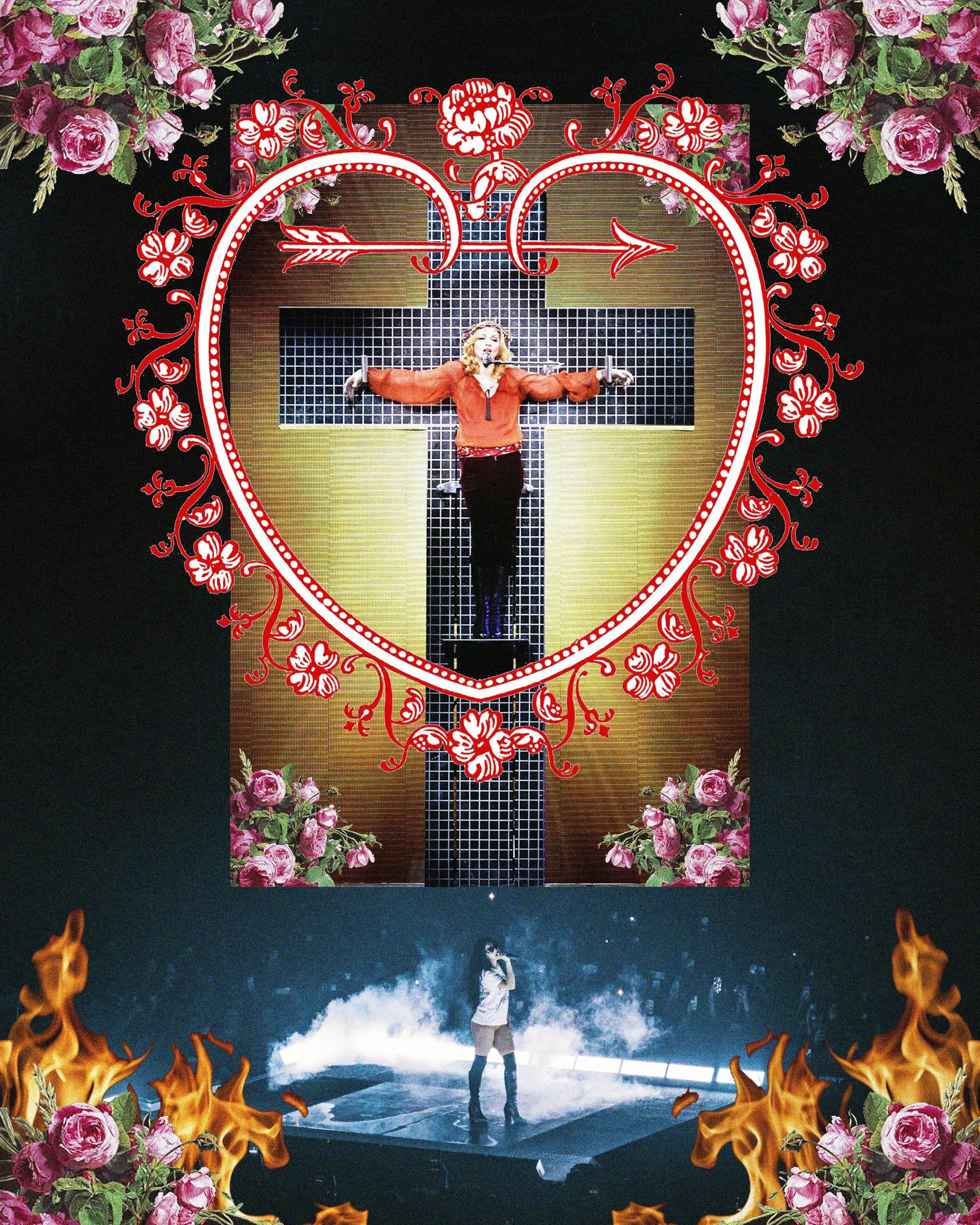
Popstars, the best popstars, inspire this spiritual practice too. Madonna wore a crown of thorns as she was crucified on a giant disco-ball cross. Sylvester and Donna Summer, Saints of the Disco, circumnavigate consciousness through their rhythmic arias, resonant voices echoing down through the decades still speak to us today. The Beatles inspired screaming ecstasies, Amy Winehouse, the Cassandra of the 00s, managed to look through the Veil of Death and sing her prophesies to deaf ears, and Lady Gaga offered herself up as a Mother to the Motherless, a Goddess to the Godless. Even Charli XCX and the vast minimalism of her highly successful Brat tour managed to position herself a portent of pagan mysticism. Where others may have filled their stages with visual stimulation and busybody fripparies, she let the vast blackness envelope her, allowing the vibrations of the audience and the dancefloor to reach up to Heaven’s vaulted ceilings. This space, this theatre of shadows is part of the Gnostic principle of the Dazzling Darkness, the space beyond knowledge, the blackness behind the disco ball, the divinity beyond God itself. Charli herself is the vanishing point, the gateway to the transcendental power of the dancefloor, which makes her betrayal that much more heartbreaking.
The dance floor is a constant in our lives because its relevance is constantly reborn, serving as an initiation for our youth, and a protective shelter for our metaphysicality. It can’t be reduced to just another micro-trend, no matter how much tiktok tries to commodify our identities, aided and abetted by those traitors to personhood also known as professional influencers. The dance floor cannot die because as long as there are people, there will be dancing. During the 2020 pandemic when nightlife was closed en masse, we turned back to nature to reinvent the nightclub. We took our speakers and our portable lasers and our tired little bodies and danced in the woods, an open air communion under the Dazzling Darkness of the endless night skies. When the world opened back up, we kept our outdoor parties because it fulfilled our need for vibrations. Our transcendence, unlike Brat Summer, never ended because it was never defined by a marketing zeitgeist, only by our own ancient histories. Claiming that the dancefloor is dead only proves how unconnected you were with it in the first place. Dancefloors don’t become unimportant when they become unprofitable, they don’t end when people decide they don’t like EDM or hyperpop anymore. Sobriety and advanced age are not insuperable barriers to communal joy, no matter what New Puritanism says. Marketability is no match for community and spiritual resistance. As long as there is life on this planet, there will be dancefloors.
When the last moon is cast
Over the last star of morning
And the future has past
Without a last desperate warning
Then look to the sky
Where through the clouds a path is formed
Look and see her how she sparkles
It's the last dancefloor
I’m alive!
…I’m alive…