
Is Married at First Sight the Manosphere for Girls?
Words: Eve Morgan

It’s a tale as old as time: boy meets girl. Or, in the case of Tyson from Married at First Sight Australia (S13), right-wing man meets hopefully “submissive wife” at the altar.
When fellow Trump supporter Steph walks down the aisle to join him, it appears to be a MAGA match made in heaven, but before the wedding is even over, Tyson brands Steph as “too masculine”. For his repeated misogynistic and homophobic spiels, Tyson is shut down by both the show’s experts and other participants, but there’s an elephant in the room. Similar outdated ideas of gender are vocalised throughout the whole cast.
Mel is looking for a partner who lets her be ‘in her feminine’, and her husband, Luke, shares her stance on ‘blue jobs and pink jobs’. One of the season’s strongest couples enters choppy waters as Filip reveals to the experts that Stella regularly questions his masculinity. Danny and Scott obsessively value themselves and others based on what kind of men they are, with gender as the only metric to hand. The insistence on categorising women as ‘mean girls’ and ‘girls’ girls’ is enough to make your head spin; every slight, every success, is the measure of a man or woman.
Reality TV purports to be just that - a representation of reality - when in fact the participants selected, the situations they’re put in, and every statement that’s kept in the edit are decisions from the production team. When this is acknowledged, consistent reinforcement of gender norms throughout the genre, particularly those that go unchallenged, can be seen as intentional. Right-wing views are on the rise across the world, and as a consequence, or perhaps a cause, dating shows are increasingly littered with gender essentialising language. Though this may feel like casual viewing, reality TV has just as much power to inform political opinion as any media, as it constructs a simulacrum of the world around us.
___STEADY_PAYWALL___
"If the internet’s ‘manosphere’ is aimed at shaping expectations of gender in men, perhaps reality TV does this in its women-led audience.”
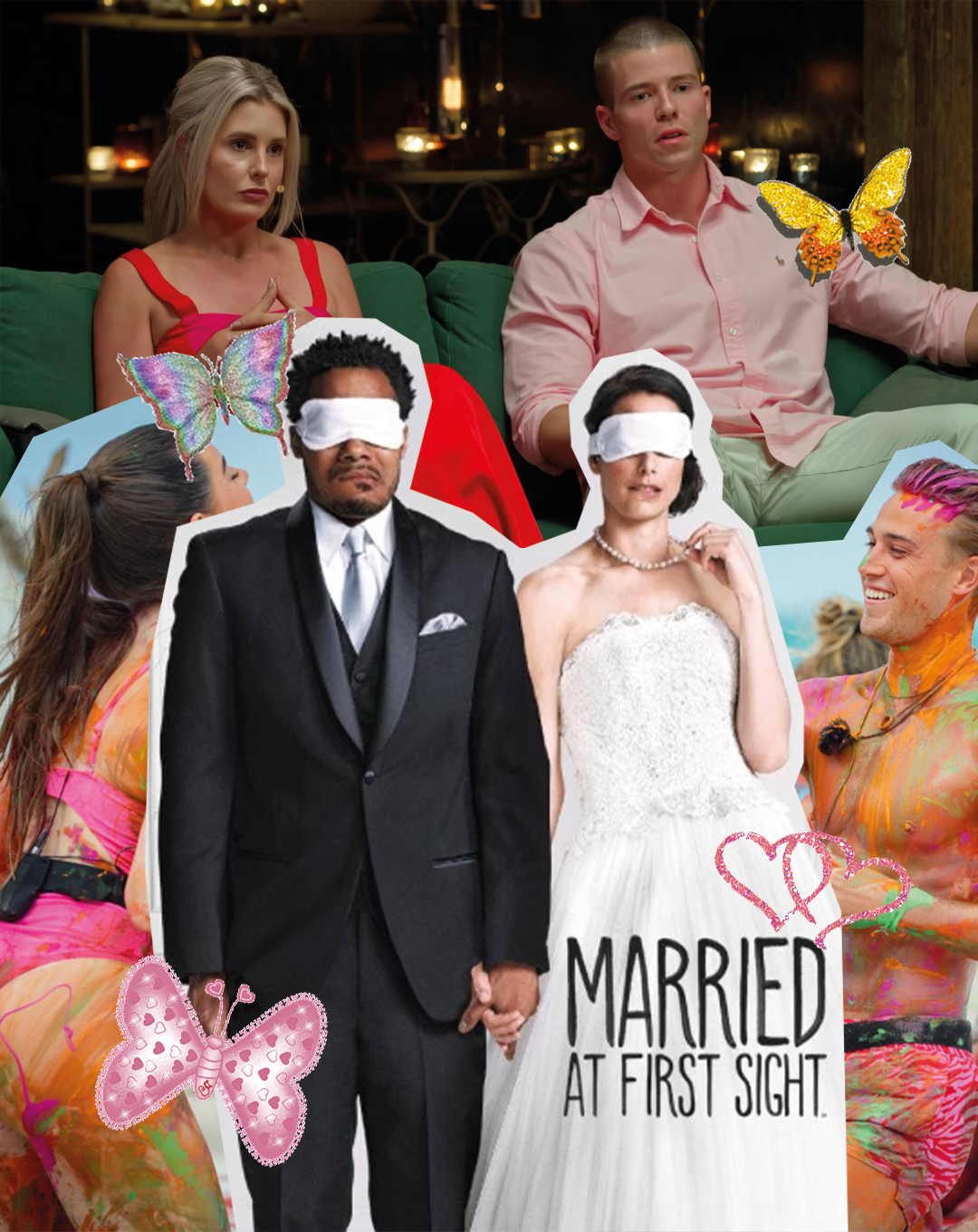
Seemingly harmless, colloquial ideas of gender essentialism fuel a culture where more extreme opinions can flourish, and it’s not just the Aussies who fall prey. In Netflix’s Age of Attraction, where participants date without knowing each other’s ages, some of the men trip over themselves to reinforce inherent differences between themselves and the ‘females’. Throughout Too Hot to Handle’s recent seasons, the positioning of gender as something othering comes not just from participants but also from workshop leaders. These sessions, often loosely invoking spiritual teachings, warn women that men’s DNA stays inside them for 50 years after sex, and that their uteruses are centres of womanly energy. The obsession with gender borders on collective effervescence.
The alignment of men and women as alien to one another harks back to a Men Are from Mars, Women Are from Venus mystification of gender. It’s a tool of social control: violating a group’s norms is one thing, but failing your gender appears to be another. If the internet’s ‘manosphere’ is aimed at shaping expectations of gender in men, perhaps reality TV does this in its women-led audience. Alongside the increasing power of the far-right, the insistence that masculinity and femininity are divine, inherent, immovable forces to be reckoned with appears to be strengthening in the general public, or at least this is what these dating show cohorts imply.
Judith Butler’s model of gender as a performance (that gender is not innate but constructed via repeated behaviours) is sometimes understood just as well by those who actively endeavour to uphold it as those who seek to dismantle it. Particularly in the shows whose premise involves ‘experts’, one may expect such ideals to be challenged more. In Blue Therapy, couples constantly reference gender roles to therapist Karen Doherty. This could have offered a rare opportunity to discuss the intersectionality of gender with race in the experiences of the majority Black cast. Instead, several men raise gendered pressures as excuses for poor behaviour, while seeming reluctant to change. As Viktor pressures partner Maria to distance herself from her family, he explains that he won’t propose until she ‘acts like a wife’. Mike’s explanation for getting his family into £12000 of debt is the pressure on men to be seen as financial and material providers. Even Shay, one half of the show’s only queer couple, seems to associate masculinity with unfaithfulness, ramping up her persona as a serial cheater when she’s around her male friendship group.
It would be optimistic to assume that queer relationships aren’t shaped by gendered and heteronormative expectations, when questioning and playing with gender has fuelled much of queer culture and art. However, offering up gender binaries as the defining axis of queerness does a disservice to the work that has been put into defying them. For example, in The Ultimatum: Queer Love, this nuance is flattened, as conversations featured in the final edit incessantly focus on which member of each pair is ‘the masc’ or ‘the femme’.
Conversely, BBC’s I Kissed a Girl felt like a vision of the ever-coveted lesbian commune. There are still conflicts, tears, and betrayals, but also open and compassionate communication, a genuine sense of community, and insightful conversations about the participants' relationships with their identities. In a genre defined by its hetero-fatalism, the franchise is a breath of fresh air. However, despite a rapturous reception from queer and straight audiences alike, it was recently cancelled.
A series featuring queer participants who engage with gender differently could have been a partial resistance against the UK’s rising culture of misogyny and TERF-ism, which puts anyone who falls even outside of gender binaries at risk, particularly trans and non-binary people. Disappointment at the loss of representation outpoured from contestants and viewers, with last season’s unofficial protagonist Amy Spalding putting it best to Gay Times: “I’ve said it before, and I’ll say it again, you can’t be what you can’t see”. Like all media, dating shows have a duty to represent the reality they claim to reflect, and exercise caution in the reality they create.
As with any form of culture, we should be discerning about the dating shows we engage with, as steady reaffirming of ideas of women and men as being so separate has the power to re-normalise the gender binary and its dangerous impacts. Reality TV has long been diminished as lowbrow, likely because of its association with women. With time and popularity, this has abated somewhat, but shifting attitudes further question its place in our culture. When the repeated decision is to echo archaic views of gender, this is an intentional reinforcement of the malicious forces that are rippling throughout the sociopolitical landscape. That these binaries are constantly reinforced even in the casual, women-oriented sphere of dating shows demonstrates just how far back the recent years of rising right-wing power have set us.