
Laura Palmer Died For Our Sins
Words: Elijah Fischer

We’re in the early stages of what can only be described as a Lynchian Renaissance. As the world backslides towards the cultural politics of the Reagan and McCarthy eras, audiences have been craving the perverted underbelly of Americana that only the works of David Lynch can bring. The surrealist’s death in the early days of 2025 only fanned those hungry flames, and for months now it’s been nearly impossible to walk into your local independent cinema without seeing his name on the marquee. As expected, the tributes have been dominated by Twin Peaks, Lynch’s biggest mainstream splash.
It seems that when Lynch is remembered, Twin Peaks is what first springs to mind. A decades-spanning odyssey across the best and worst parts of small-town America, the show has had surprising cultural resonance even beyond red, white, and blue borders. The series famously has a massive presence in Japan, Latin America, and even Russia. But what drew these international audiences to a show so aggressively American that cherry pie is practically its mascot? The answer is simple: people resonate with a good martyr, and no martyr is quite as fitting for the end of the Reagan era as homecoming queen Laura Palmer.
Much of Twin Peaks is spent trying to find out who Laura Palmer really was, while dancing around the fact that none of the characters really care about that answer. Like so many women and girls, her existence is reduced to what needs she fulfilled for everyone around her. Daughter, girlfriend, friend, madonna, whore. Until Twin Peaks: Fire Walk With Me was released all the world knew of Laura Palmer was a homecoming portrait and a beautiful corpse. As is the case with so many martyrs, Laura Palmer became an abstraction, only as real as people’s memories of her. For the crime of being an imperfect victim in life she was condemned to exist only after her death.
___STEADY_PAYWALL___
“Everybody loves Laura Palmer, but no one really cared to know her. In a time where empathy is in crisis, there is so much to be gleaned from Lynch’s vision of Jesus as a teenage girl.”
Though he was more spiritual than religious, Lynch often took inspiration from Christian iconography. Bible verses proved the beginnings for films like Eraserhead and Inland Empire, so it isn’t far-fetched to assume Laura Palmer’s martyrdom has some Christ-inspired tinges to it. From her body being wrapped in a shroud that literally reflects her image, parallels between stab wounds and stigmata, and even the requiem piece “Agnus Dei” scoring her murder in Twin Peaks: Fire Walk With Me, Laura Palmer’s sacrifice to expose BOB for who he really is and stop his cycle of abuse from continuing turns her into a female Jesus, dying for man’s sins in more ways than one.
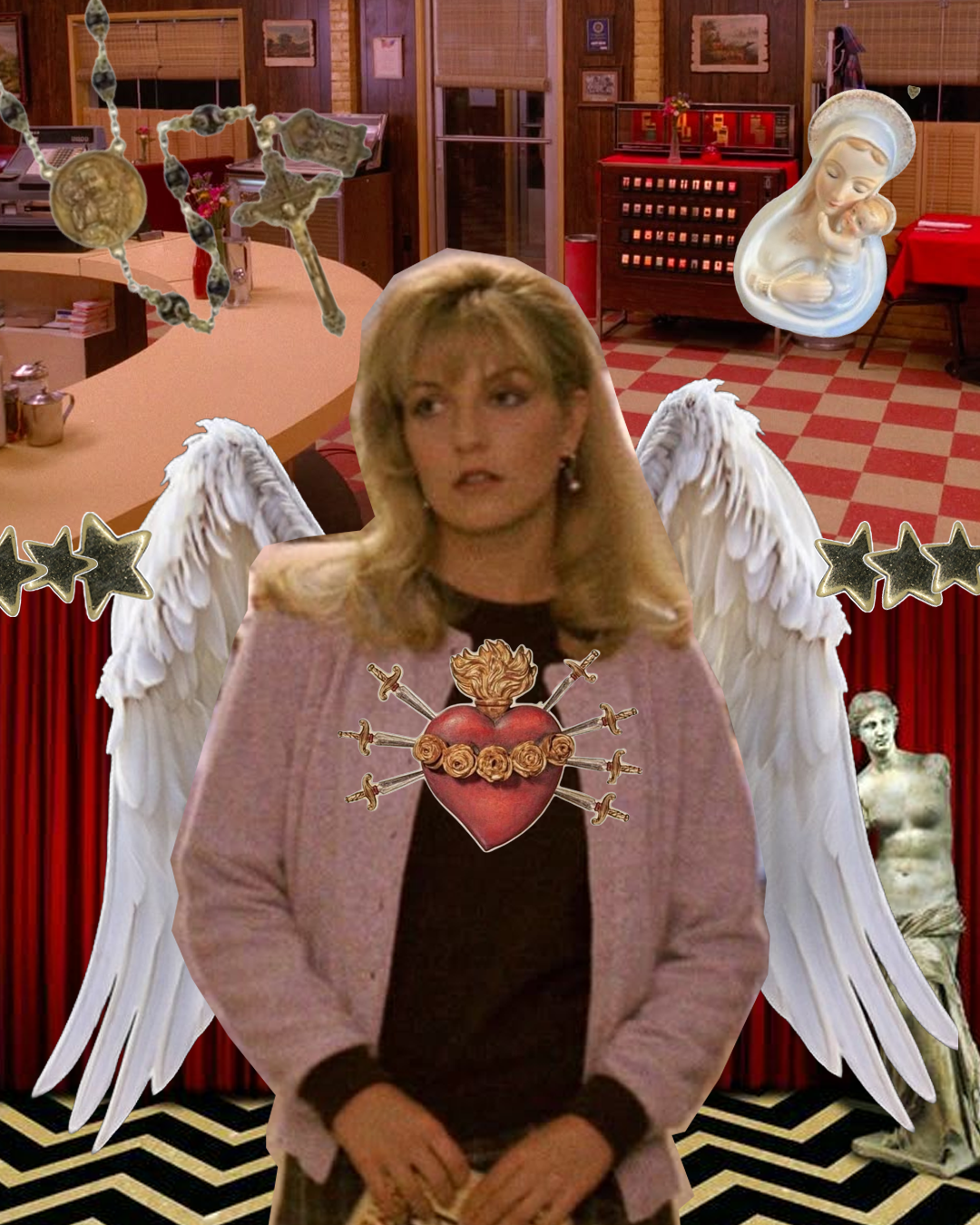
As a result, Twin Peaks has grown beyond even cult status. It has become its own religion, with Laura Palmer at the centre. Mock funerals have been staged, fans place framed versions of her homecoming portrait around their houses as if she were their own daughter, people weep over the loss of a girl who was never really here. Laura has become an abstraction of a different kind: a symbol across cultures tormented by femicide, systemic abuse, and misogyny rooted in tradition.
Almost 36 years after the premiere of Twin Peaks its cultural clout hasn’t wavered. Everything old is new again, so it’s no surprise that Gen Z is flocking back to the Double R Diner as the politics of the Reagan era rears its ugly head once again, trying to convince us that abusers come in the form of decrepit outsiders rather than frighteningly familiar faces. However, another trend is also emerging from the depths of our disturbingly conservative cultural climate: young people are turning to Christianity. A study from Barna claims that churchgoing rates among Gen Z are doubling that of previous generations. Whether that is rooted in a return to the “traditional” values that plagued the Reagan and McCarthy eras, the simultaneous Twin Peaks resurgence highlights the darker sides of a generation desperate for connection and understanding. It’s clear, then, that the power of Biblical storytelling holds sway over Gen Z.
Lynch’s legacy is one marked by empathy above all else. In all of his works, in all of his visions, the importance of kindness and understanding takes on a borderline holy quality. Unfortunately Gen Z is starved of empathy, poisoned by isolationism and culture wars that are preventing primarily young men from embracing the age old adage: “love thy neighbour”. Coming off the back of the bootstraps Reagan era, Twin Peaks is a show haunted by this future - by the possibility that love is not enough. Everybody loves Laura Palmer, but no one really cared to know her. In a time where empathy is in crisis, there is so much to be gleaned from Lynch’s vision of Jesus as a teenage girl. Laura wasn’t a perfect victim, but she was undeniably kind. In spite of all of her suffering, and in spite of the world turning a blind eye to it, she never stopped trying to protect others from that same suffering.
Sacrifice is what separated Laura Palmer from the rest of Twin Peaks, just as sacrifice is what separated Jesus of Nazareth from the rest of the world. Their kindness came at the expense of themselves, a foreign concept in today’s Americanised “me-first” status quo. Religion and feminism may act as oil and water, but Lynch’s spirituality and singular mind managed to reimagine the baser meanings of the story of Jesus Christ for modern America. What he created was a story so powerful, so raw and wrought with truth, that it has been passed across borders and generations with nothing being lost in translation. The story of a good martyr holds an untold cultural power, one that may even have the power to bridge our current drought of empathy. The fact that young people are still returning to Twin Peaks, still desperately searching to find out who Laura Palmer was, proves that hope is not yet lost. Empathy can spread by osmosis, and if anyone can emotionally educate our red-pill poisoned brains, it’s the late great Lynch.