
The Rise Of The Eco-Hobby
Words: Callie Byrnes
Make it stand out
I spent five hours yesterday unraveling sweaters, which is about as glamorous as it sounds. Front to end, it’s a tedious job that begins with sifting through recycling centers for well-made garments, washing and preparing them, cutting out all the seams, and then painstakingly unraveling each panel.
“We’re saving money,” my friend likes to point out cheerfully as we roll the secondhand yarn into skeins, pretending to ignore the amount of time we’ve lost in the process.
It’s not really about saving money, though. If anything, this venture was born out of a growing urge to save the planet. We’d seen the videos online of creatives upcycling materials and encouraging others to give it a try, it’s worth it, I promise. Enter the eco-hobbyists: crafters and artists who have shifted their creative processes to account for the fact that the world is figuratively (and sometimes literally) on fire.
You may have seen some of their projects on TikTok without realising it, because the outcome is usually more interesting than if they’d used manufactured products. These creators make sequins out of food waste and natural dyes from flowers in their gardens, which they seamlessly incorporate into their art. But for eco-hobbyists, their work goes beyond the artistic factor, and it’s no coincidence that it’s a niche that’s growing in numbers. When you factor in all the materials you need for a hobby, it can be surprisingly expensive; using what you already have lying around and scrounging up thrifted materials feels ideal in more ways than one. ___STEADY_PAYWALL___
Did you know 92 tonnes of textiles end up in landfills every year? And that a sizable percentage of that is made up of manmade plastic fibres, which means they can’t even decompose naturally? I didn’t until I started learning more about textile arts, but now I can’t unsee it.
We’re so used to mass productivity and its consequential waste that many people rarely give it a second thought, but there was once a time when upcycling materials was a necessity due to the scarcity of supplies. It wasn’t until industrialisation brought the convenience of mass production that sustainable art became rarer but louder—a statement instead of the status quo.
While wealthier artists created the Arts and Crafts Movement to push back against Industrialism in favor of craftsmanship, it was folk art that allowed the everyday person to contribute to this ideology. During the late 19th century, woodworkers called tramp artists reclaimed scraps from discarded crates and cigar boxes as a way to protest taxes that made them otherwise unreusable; unsurprisingly, this art style became even more popularized during the Great Depression, when people were unable to afford new materials and forced to make do with what they had. It wasn’t just about protesting overconsumption—it was pragmatic.
“There’s a certain satisfaction to knowing that, as companies continue to commodify hobbies and upsell cheap materials, you can do something good for the world instead.”
But sustainable art took an ecological turn in the 1960s as artists began creating work out of materials like rocks, soil, and water and using natural landscapes as their canvases. This land art focused less on the finances and more on environmental activism, urging their audience to consider nature in a new light and do what they could to protect it. It wasn’t until a few decades later that Recycled Art emerged, with artists literally turning trash into something with renewed value.
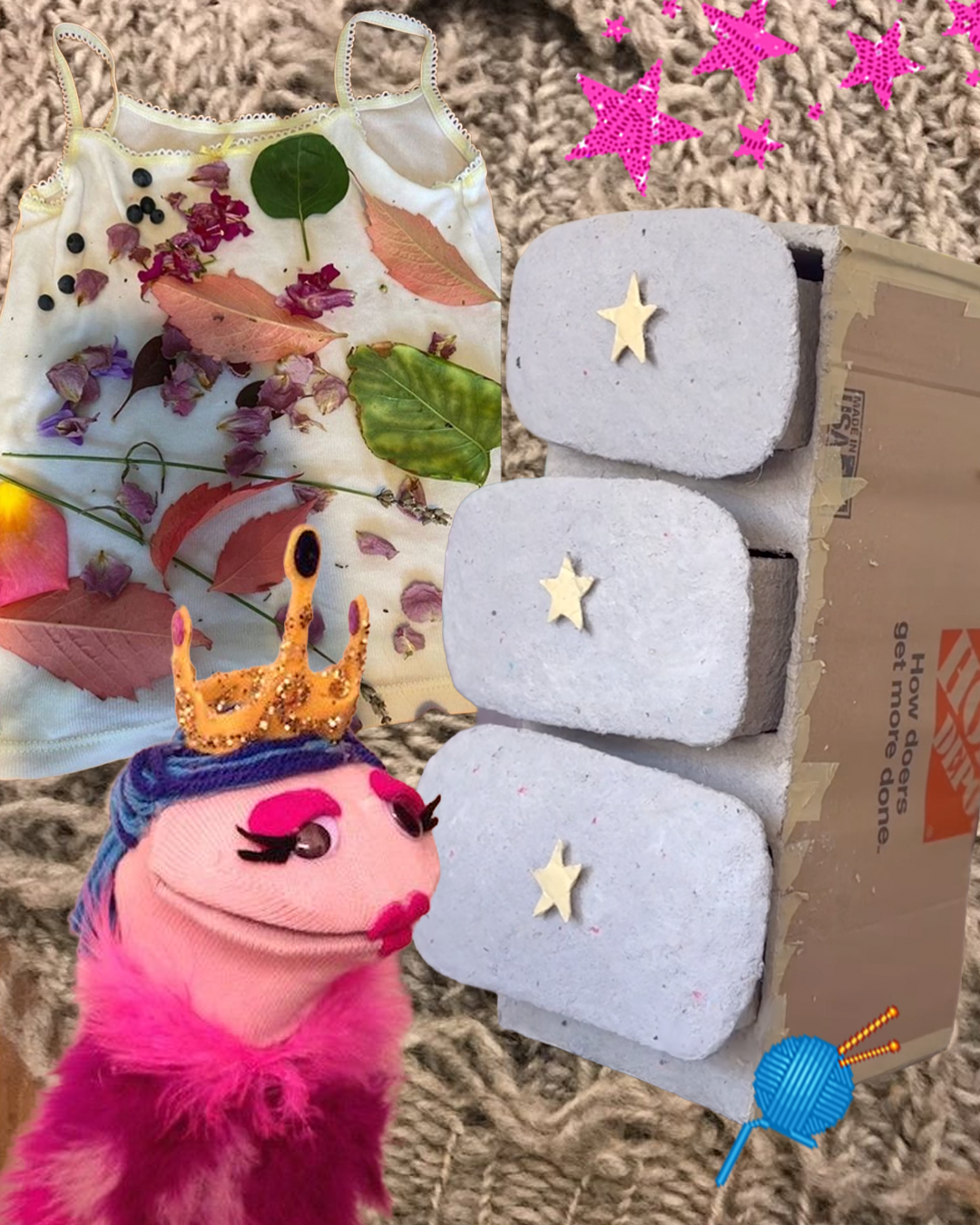
Now eco-hobbyists are doing the same thing while documenting their processes on their phones. Like woodworkers sourcing crates for scraps, artists like Dansy Thomas (@slugdealerrr on TikTok and Instagram) create sculptures and furniture entirely out of recycled paper, boxes, and packaging. Instead of buying newly produced plastic beads from a craft store or bulk packs of sequins on Amazon, creator Kaitlyn Kraybill-Voth (@iamjustananimal on TikTok) makes her own from old takeout containers and soda cans.
“This sounds like such a cliché, but you really do start finding inordinate amounts of joy when finding the perfect ‘trash’ item for your project,” Kaybill-Voth wrote in one caption. In this way, sourcing the materials can quite literally become one of the most innovative parts of the creative process.
Still, for many, it might not seem worth it, especially when you factor in the price of convenience. But for eco-hobbyists, it’s a small charge compared to the larger cost, and making a change and not making change is the entire point.
“I think you do have to have a full reset of your relationship with the world and how important your personal actions can be to make a difference,” explained craftivist Tori Thurman, known as @thecraftygrrl on Instagram, who started using eco-materials as a way to save money and later adopted it as a way of life. “The barriers for entry are actually very minimal once you truly believe in the why behind it and not because you are doing it because it’s trendy.”
There’s a certain amount of freedom that comes with knowing you have full control over what you create, even down to its environmental impact. There’s a certain satisfaction to knowing that, as companies continue to commodify hobbies and upsell cheap materials, you can do something good for the world instead. Even when it seems like a small act in the grand scheme of things. Even when it eats away large chunks of your already-limited time.
“We need a work song we can sing together,” my friend said after the third hour of unraveling a single sweater. “You know, like they used to do in factories. Like in Snow White.”
My back ached from hunching over and I was growing restless, but I couldn’t stop myself from laughing. Believe it or not, we knew how ridiculous the whole thing seemed. I would argue most eco-hobbyists recognise anyone on the outside looking in won’t always get it, but what are our other options? Either you give up or you give in. Sitting across from one another, unable to control our laughter, we chose the latter.
See, we’re having fun! See, we’re saving money! See, we’re saving the planet one discarded sweater at a time. Is it worth it? A better question might be: If it isn’t, then what in the world actually is?