
Words: Beau-Belema
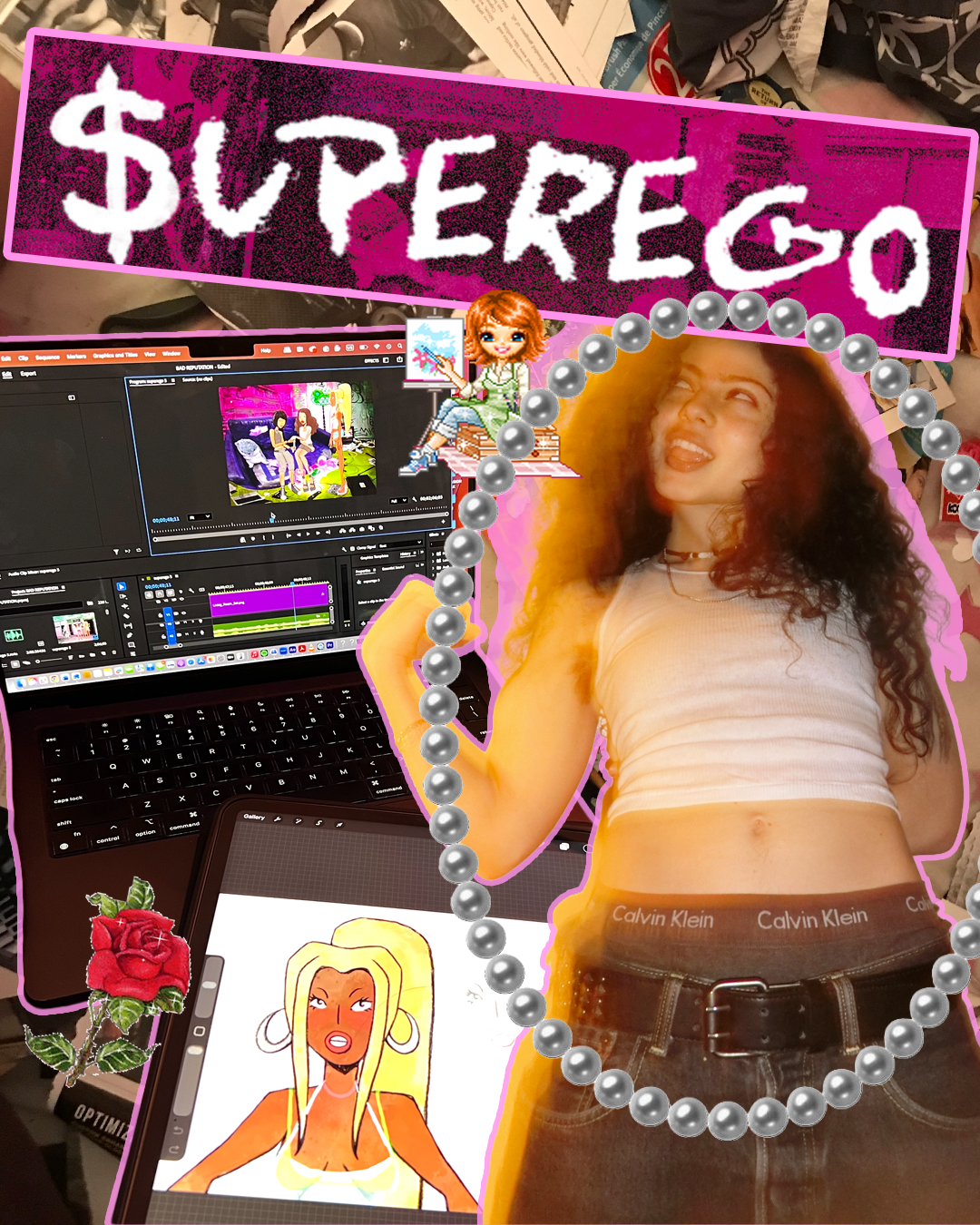
$UPEREGO is undoubtedly for the girls. The animated series is currently platformed on Instagram, YouTube and TikTok under the username @superior.turbinate and has gathered a following of over 330,000 across all platforms in the past two months.
Scratching that nostalgic itch, Friday uploads wrangle us back into a routine reminiscent of the one Gen Z-ers grew up on, the same internet with the same TV programs, bonded over shared experience. However, many recognise what $UPEREGO does uniquely. It re-educates and inspires, in the nihilistic language Gen Zs understand that inevitably gives way to hope. When we’re not saying ‘literallyyy’, we’re excited that our show is on, and though it’s for the girls, guys who allow themselves to enjoy concede, saying ‘‘I’m not supposed to tell the bros that I like this’’, but what’s not to like?
$UPEREGO follows friends Via (Id) Blade (Ego) and Yara (Superego) through life in a hyper-reality as they navigate their teens, and ask the important questions. I spoke with creator Evangelia Artemis-Gomez about late 90s–2000s nostalgia, hopepunk, philosophy and preserving her memories of New York City in the colourful and hilarious world of $UPEREGO. ___STEADY_PAYWALL___
Let’s start with the basics - Tell us about yourself, how you got into animating and the inspiration behind $UPEREGO.
I was born and raised in New York City. My mom is from Greece and my dad is Jewish Puerto Rican, so I’m extremely New York.
When I was little, my mom was a cartoon colourist for Codename: Kids Next Door. Visiting the studio, Curious Pictures, and watching her work showed me it was possible to put my all into storytelling. I’m also inspired by Ralph Bakshi as well as cartoons of the 90s and early 2000s like Daria, Downtown, and internet animation like David Firth’s Salad Fingers.
When I was 17, I made a comic book series called Via. I used it to synthesise my experience as a rowdy teenager and the horrors of adolescence. It was mostly about Via; Blade made a cameo or two but Yara wasn’t fleshed out then.
In college, I took a basic After Effects class and we had an assignment to create a 10 second soundless video inspired by a fable. I made an animation, using the characters from Via and then my girlfriend and Animal Angel bandmate, Carmen Caska produced the music. I submitted what ended up being the first episode of $UPEREGO - which was not 10 seconds or soundless - but I called it Mad Tea Party after Alice in Wonderland, so it would be on theme. The professor liked it and said I could keep making these for the rest of the semester.
What led to you turning these Freudian concepts into three baddies going through the city?
I found Freud and Jung as a teenager who wanted to figure out if I was a good person without talking to adults about it. I was interested in the id, ego, superego dynamic but the typical representation of angel on one shoulder, devil on the other, felt played out. I thought it would be interesting to personify self-regulation through a female friend group; how we check each other and validate each other. It’s a good vehicle for the kind of moral quandaries I want to explore.
$UPEREGO could easily air after Daria or Downtown, but there are critiques of the resurgence of early 2000s nostalgia in the present day. What do you make of that?
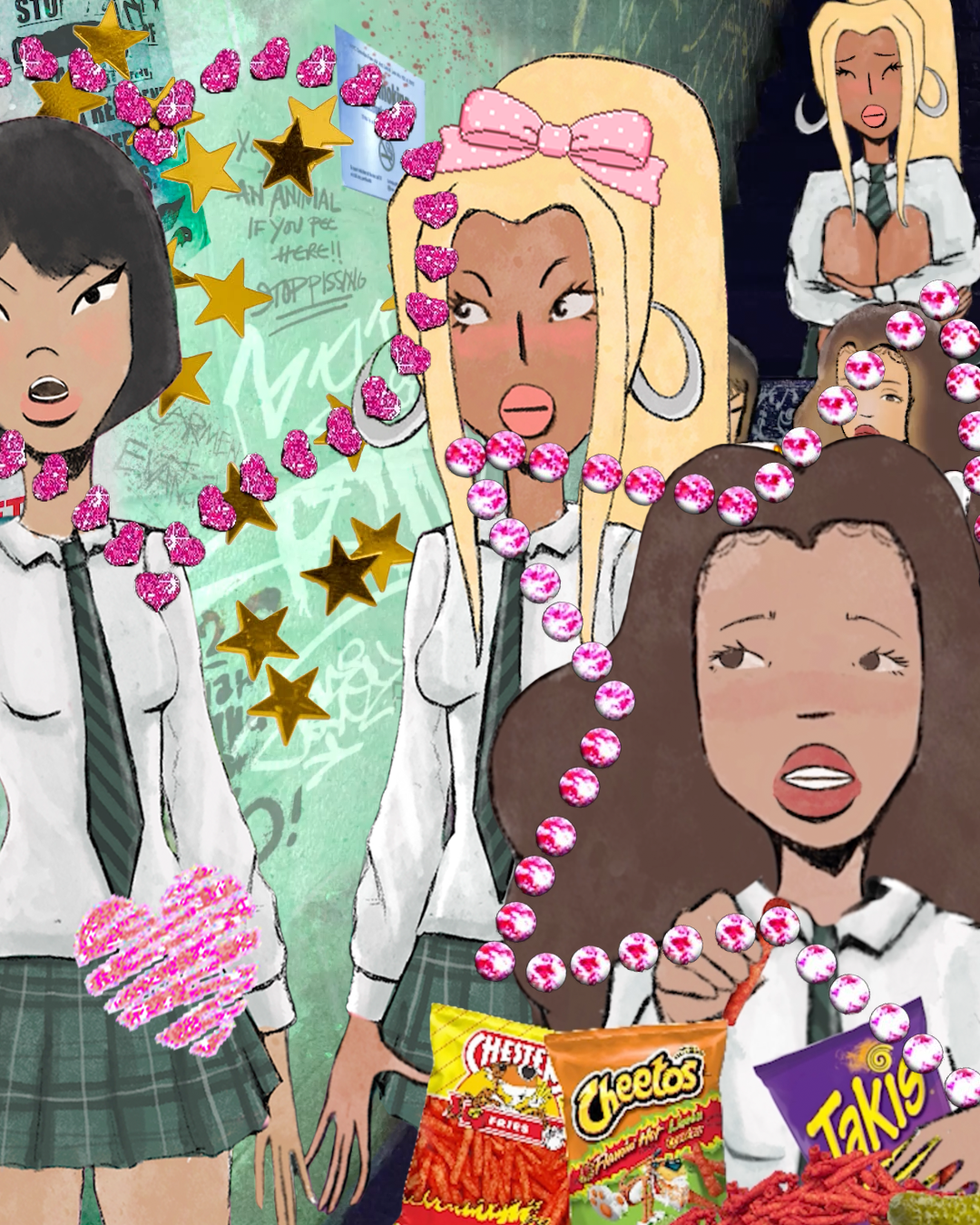
I’m honoured when people say that $UPEREGO could’ve been alongside such strong programs. I love media from the 90s and 2000’s. Yara’s monologues are inspired by 90s punk, feminist archives and outsider art I consumed in my teens. But in terms of the grip nostalgia has on our culture right now – I think nostalgia keeps people stagnant. It’s good as a spark to keep things moving but it’s important to analyse what you like about things and adapt it. What makes a piece strong is the blend of timeless narrative elements that apply to current generational gripes.
Talk to me more about the bright, grimy settings in $UPEREGO.
I love when people comment ‘This is so New Mexico’, or Melbourne, or Toronto or London because I’m trying to capture a universal experience. The background collages are made with images I've taken in Puerto Rico, Greece, and New York so my cultural heritage is embedded in the show, but I love that people all over the world resonate with the heart of it.
Sometimes I think New York feels like public domain, to complain about because people forget that some of us have lived here for generations. You wouldn't go to someone’s hometown and say ‘ew it’s so dirty’ or run around trying to change it to be something else. I wish people paid New York the same respect.
I’m really inspired by the beauty in the grime, vibrant color, and texture of the city I grew up in. There’s comfort in the grungy parks or the same guys who’re always outside the bodega. You find the most fashionable, interesting people in places you wouldn’t expect if you’re not born and raised here. People push those ‘strange’ corners to the side, but that's where underground scenes develop before they get co-opted.
The girls in $UPEREGO are in no way isolated from that world around them, there's a community; my entire family lived on the same block, and now all those people have passed and the places I used to go are getting torn down. Corners of the city you wouldn't think would dissipate, are dissipating. I want to preserve what all of that felt like in the media so it doesn’t disappear, and so people can see it is possible to have these communities. I want this to be an everlasting world that can house these emotions.
How was growing up as a teenage girl and interacting with Freud, Jung and Watts and what do you hope people do with your takes on them?
I don't want to generalise, but from my experience girls tend to internalise things a lot more. The burden of accountability is expected of them – to behave better, to think of how our actions will affect others to the point of being perpetually self conscious. Obsessing over gendered expectations was exhausting, and so I wanted to seek out answers.
As a teenager I was anxious, depressed and had substance abuse issues but there was a hope in me that wouldn’t die no matter how hard I tried to kill it. I ended up interacting with works by Alan Watts and tried to turn my nihilism into a sense of absurdism and excitement for the world. It doesn't have to be ‘lay down or die’ when we accept that we exist within structures that are clearly wrong. I feel like a lot of my generation has this spark of hope to move beyond irony, and figuring that out is complicated and it’s what I'm trying to do.
I like “hopepunk” as a term I’ve heard. In little moments in $UPEREGO I want people to see that there is something to aspire to. Better versions of ourselves and the world exist, we just need to seek them out.