
What Wigs Can Teach Us About Irreversible Self Commodification
Words: Nadia Trudel | Images collages from Tomihiro Kono
I probably think about the panopticon once a day, wondering who could be watching me. Was my occupational therapist viewing my LinkedIn profile? Could my co-worker have seen my TikTok dancing to RuPaul’s “Jealous of My Boogie?” Is anyone still reading the book I wrote on Wattpad?
Every once in a while the guard knocks on the door: I meet a girl at a reading and she asks if I’m @witnessaccount; my name ends up on an Excel spreadsheet involved in local literary drama; over a year after our first (and last date) someone replies to my Instagram story to call me a bimbo poser because they read my work.
It’s all relatively innocent, yet as facial recognition technology leads to criminal charges, secret public bathroom cameras torment, and the whims of strangers land civilians in deepfake pornography, anonymity finds a sense of urgency. Until I figure out how to become a lighthouse keeper, I can’t exactly scrub my extensive digital presence or abandon the city, really, I don’t want to. I must confess my reasons for writing professionally, posting thirst traps, or performing elaborate karaoke numbers are not purely artistic— so, fine, I’m an attention seeker! What’s a girl to do?
___STEADY_PAYWALL___
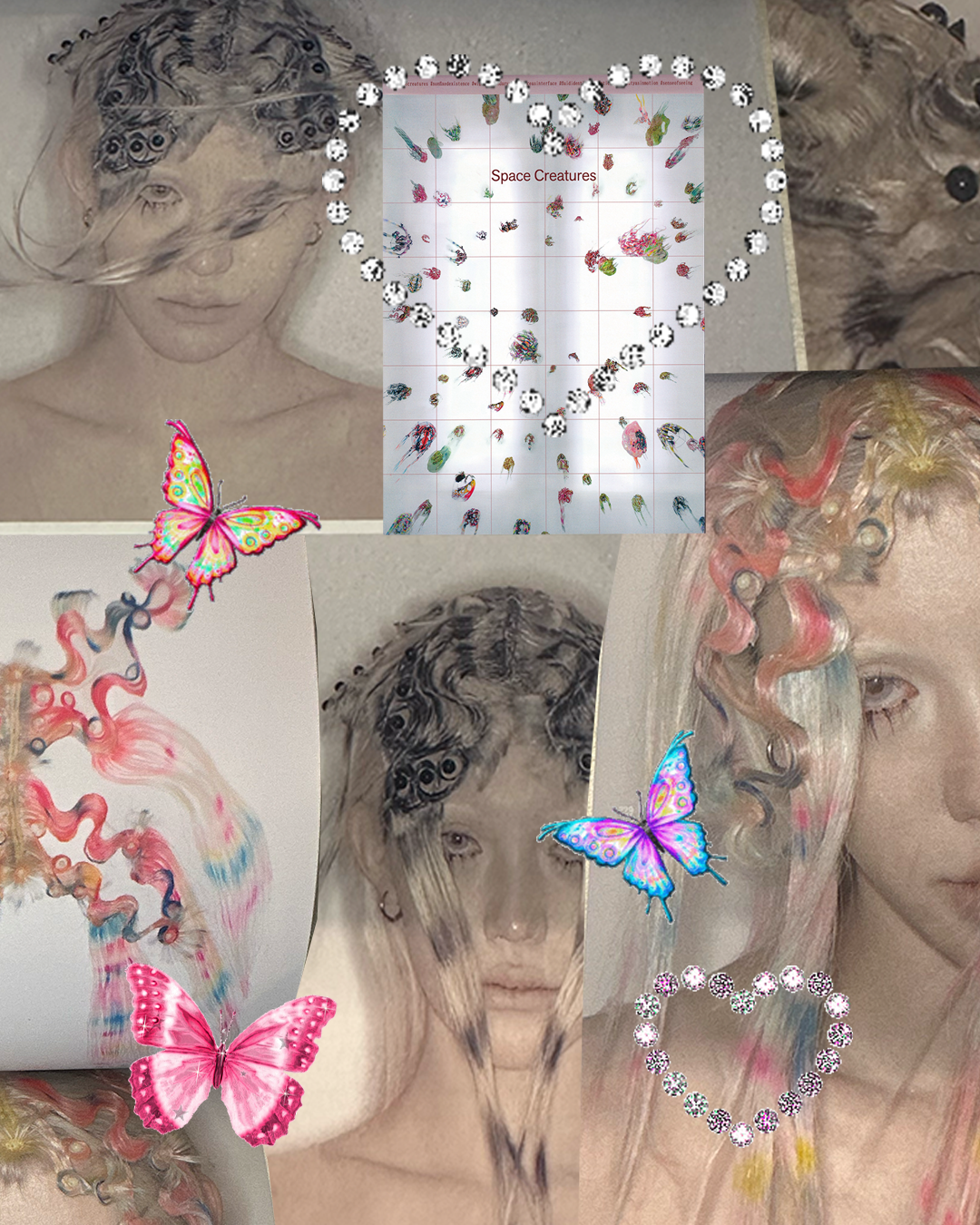
Well, what about wigs? There’s an inherent mystery to wigs and everything they hide, and they might be the answer to our current cultural identity crisis. Wigs can conceal balding, damage, vanity, a K-Pop idol’s comeback dye job, a popstar’s real self. No one understands that better than Tomihiro Kono, the iconic wig artist testing the possibilities of hair. The mystery of Kono’s wigs is less ‘Is that her real hair?’ and more ‘Who is that? What is that?’
This became especially evident to Kono’s frequent collaborator and partner, the visual artist Sayaka Maruyama. While editing photos for Kono’s latest book Space Creatures, she discovered that some of the wigs made faces undetectable to facial recognition systems. The book presents wigs created from 2022-2025 as selectable identities, alien organisms on display which blur the lines between human and inhuman, individual and system.
“Classically, transformation is a before and after narrative. The ugly duckling becomes the swan. The end. This makes it difficult for many to understand folks whose gender identities or sexual orientations seem to be ever changing.”
Kono explains in the book “This may be because the wig functions as a device that disrupts and agitates the existence and structure of the face itself. How, then, should we handle our faces in the future? Faces for expression—and faces for recognition.”
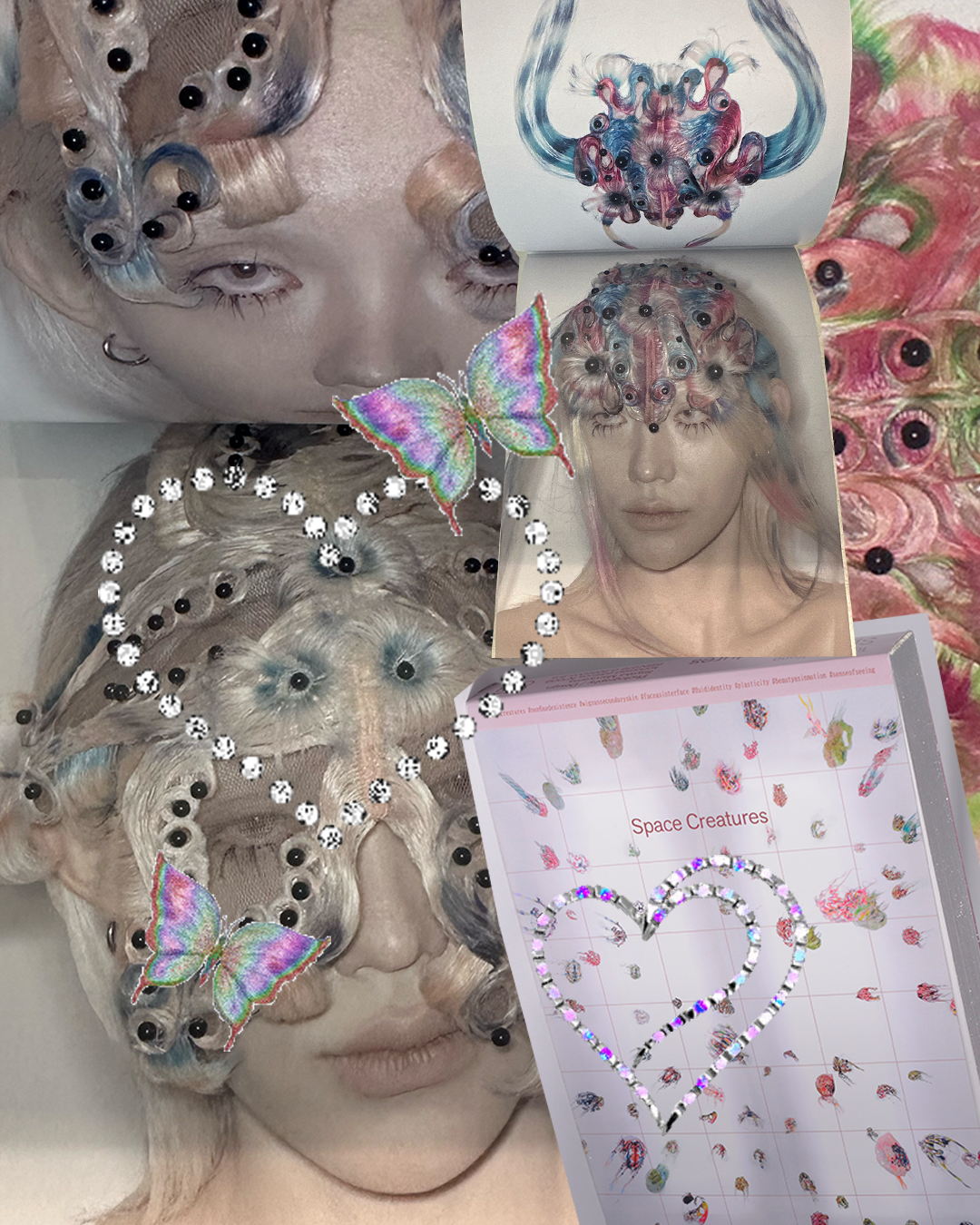
Starting with the publication of Personas111 in 2020, Kono has been examining the links between hair and identity, initially through bright colours and eccentric cuts and styles, before pushing further in 2023’s Fancy Creatures by embracing the otherworldly possibilities of hair, particularly through sculpture and texture, where many faces become obscured by creature tendrils or anime bangs.
Maruyama’s discovery highlights a contradiction happening between the visibility and invisibility offered by Kono’s bold beautiful wigs. It made me wonder whether anonymity was synonymous with modesty, camouflage, and monotony, sacrifices for anyone who enjoys fashion, beauty, and art.
For years, journalists have written about the disruptive “anti-surveillance” potential of beauty and fashion, a term largely applied to strange geometric makeup, face coverings, and confusing patterns designed to elude detection and identification. Despite numerous headlines, these designs have remained more conceptual than practical, mirroring the gap between runways and consumers. The technical necessities of “anti-surveillance” beauty and fashion mean the designs operate on limitation rather than abundance, making the price tags and time commitments less appealing. That’s what makes the anti-surveillance potential of Kono’s wigs so interesting - it’s incidental to the aesthetic.
“The way we perceive and use our faces has shifted, especially since we live in the age of social media. We spend so much time thinking about how we appear to others—the face we want to show, the face that’s being seen. In a sense, our faces are the first interface we use to relate to and communicate with others,” he writes to me. “Because of that, having just one fixed face per person might feel increasingly limiting. The idea that there’s only one face recognized by digital systems, and nothing else, can start to feel constraining.”
Transformation carries a lot of baggage. There are connotations of damage, deficiency, superficiality, indecisiveness, and deceit—see anti-trans and anti-drag hysteria. Classically, transformation is a before and after narrative. The ugly duckling becomes the swan. The end. This makes it difficult for many to understand folks whose gender identities or sexual orientations seem to be ever changing.
Challenging the perception of identity as a fixed and sacred object is subversive for reasons ranging wildly on the political spectrum, but who tends to gain the most from labels?
It’s counterintuitive for many, in the age of self-commodification, to be inconsistent. You have to post consistently to get good engagement, you have to take consistent photos to maintain an aesthetic grid, you have to stay on brand to please your followers and clients. Consistency is useful for your boss, for your targeted ads, and for your stalker. Try as I might, my playlists will always be eclectic, my attention divided, my interests diverse, my identity ever evolving, and I’ve always rebelled against even innocuous attempts to pigeonhole. In my own way, I want to be everything.
As Sylvia Plath famously bemoaned, “I can never be all the people I want and live all the lives I want. I can never train myself in all the skills I want. And why do I want? I want to live and feel all the shades, tones and variations of mental and physical experience possible in my life. And I am horribly limited.”
Elaborate wigs (unfortunately) won’t save us. But we can learn from them. Through aesthetics, we can experiment, play, transform, subvert expectations, transcend marketing demographics, make it difficult for tech and its overlords to box us in or pin us down. What if transformation is a sign of abundance? One that makes it a little difficult for the panopticon to watch you. After all, it’s difficult to shoot a moving target.