
Botox, Beta Blockers and the Politics of Numbness
Words: Meghan Williams
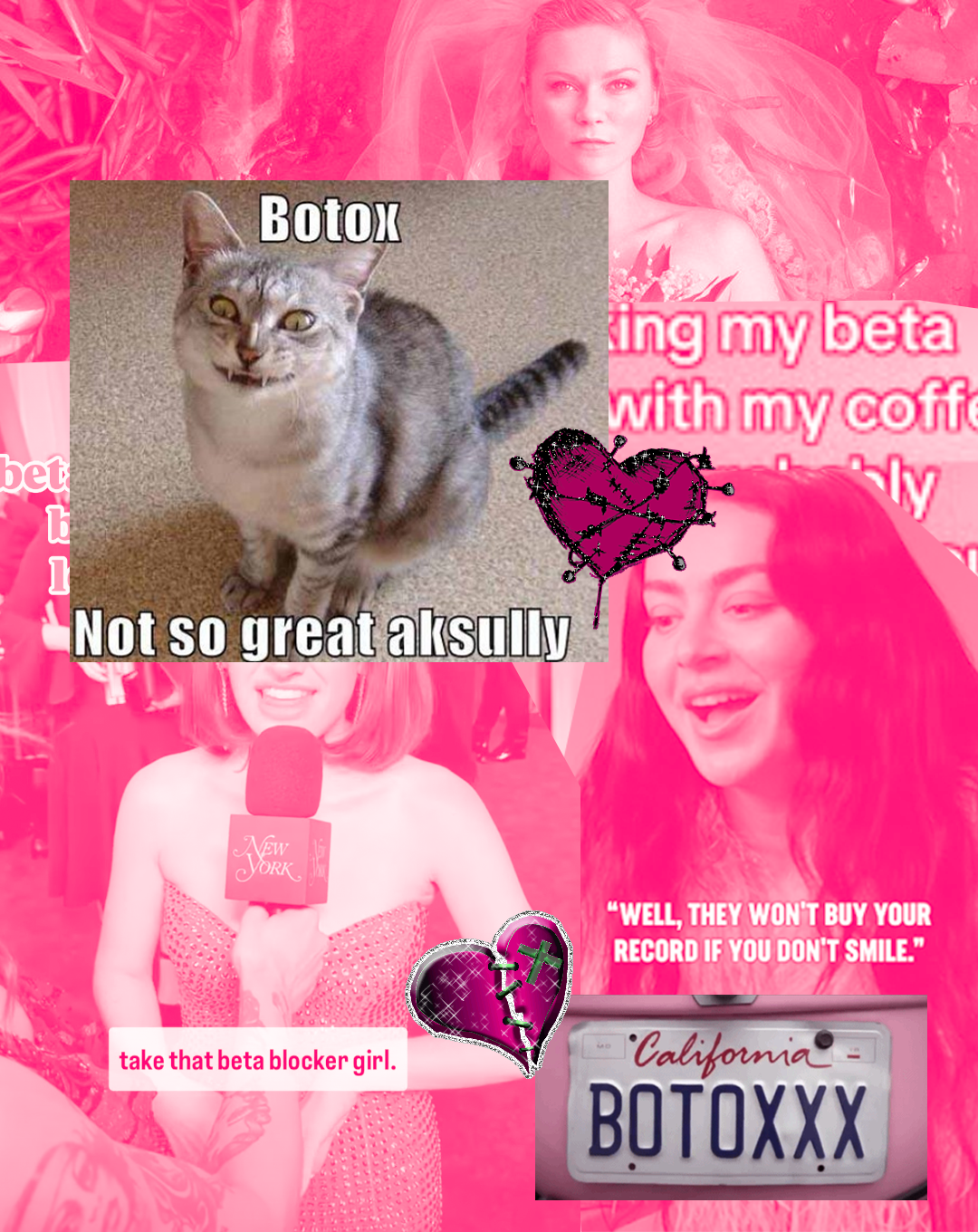
Last year, at the 97th Academy Awards, actress Rachel Sennott was interviewed by Number One Journal. “I look in the mirror and I go 'take that beta blocker girl. Swallow it down and lock in',” Rachel says.
“Numb is in,” the interviewer replies.
“Numb is in.” Rachel confirms.
This moment went largely unscrutinised over the last year, until Zara McIntosh did a dissection in her ‘Taboos on the Bus’ series. She discussed the rise of Botox, Ozempic, and the deadpan internet persona and explored the ways in which numbness is becoming deeply intertwined with modern standards of femininity.
Take the lobotomy chic aesthetic, which glamorises dissociation, or the fact that injectables literally impair people’s ability to show emotion as examples. While this might be a way of eschewing expectations for women to always be polite and friendly, Zara says it could also be caging us in a state of neutrality in a time where we need to be advocating for our rights.
The fact that women from marginalised groups have seen their negative emotions used against them - via, for example, the “angry black woman” stereotype - proves that emotions like anger don’t conform to patriarchal expectations of how women should behave. In light of the rising popularity of the far-right and associated tradwife content, it’s important to acknowledge that numb women are also quiet and passive women. Furthermore, for some it may be a choice, but numbness has been forced on others to navigate a world their oppressors have built.
___STEADY_PAYWALL___
In fact, if you look back at the stereotype of 50s housewives and their “little helpers”, i.e. whatever cocktail of meds they’d been prescribed to deal with mental health issues, or lobotomised “hysterics", women have always been better liked when sedated. Some might argue that under oppressive patriarchal standards, some women might have also preferred it.
“The scale of the problems we’re facing might make us feel powerless at times, but if our emotions weren’t powerful, the system that oppresses us wouldn’t feel the need to numb them.”
What has gone largely unsaid, however, is that emotional numbness - that feeling of being dead inside - is often a response to trauma or grief. When we face a problem we can’t fight off or escape, our nervous system’s last recourse is to freeze or shut down. That’s when we lose motivation and start feeling detached even from things that once made us happy. Sometimes, this can be a coping mechanism carried through from childhood that we rely on long after the threat has passed.

The danger presents itself when we start to rely on other things that silence our thoughts and numb our feelings, whether that’s a mood-altering substance or simply our devices. Developing a dependence on the instant gratification from things like social media can even be counterproductive when trying to escape numbness. By overloading our dopamine system, we dull the neural pathways responsible for motivation and joy, making it all the harder for us to feel them.
But then again, emotional suppression is crucial for the continued survival of the industrialised capitalist system. How else could people endure soulless 9-to-5s if not by numbing “irrational” feelings that would affect their efficiency and professionalism? Or resign ourselves to the fact that large scale environmental destruction is being done in our “interest” as consumers if not by distracting ourselves with endless amounts of content?
“It’s not a coincidence that emotional literacy amongst Western men is so low, that there is a very deep lack of emotional literacy that is by design,” says Adam Aronovich on an episode of The Emerald podcast. Whether it was during the height of the settler colonial project or now, emotional sensitivity is not seen as a virtue for leaders to have. Only those capable of making cold and calculated decisions like the exploitation of people and nature for profit fit the hegemonic conception of masculinity we still hold today.
This shows how, whether you’re the exploiter or the exploited, fulfilling our roles in the system becomes unbearable without the prerequisite numbness. On the other side of the coin, those who struggle to suppress their feelings will see them pathologised as hypervigilance, hypersensitivity, and neurodivergence and be shamed for failing to conform.
Are we right to sedate ourselves in order to survive these chaotic times? The real problem with placation is that numbness begets inaction. Nothing will change until we shake ourselves out of our stupor. Everything is not going to be alright. If we ask the universe for what we want, it will not inevitably provide it. As long as we remain passive observers of our realities, the vicious cycles we find ourselves in will only worsen.
It's worth noting that no matter how much we repress our emotions, they will find ways of making themselves known. Stress, anxiety, and fear show up in our bodies as tension and illness if we don’t express them. It may be tempting to take refuge in numbness - sometimes the emotional exhaustion forces us to - but numbness cannot become our permanent state. Desensitisation doesn’t just close us off to negative emotions, but to feeling in general. The opposite of numbness isn’t just pain, but also love, joy, and hope.
What alternative do we have to suppressing our emotions in the face of an endless newscycle of catastrophe after catastrophe? One answer that garnered much attention in recent years is rage, female rage. “Anger is the emotion that best protects us against danger, unfairness, and injustice. Understanding it and learning to think about its methodical uses in response to threats like these allows girls and women to move from passivity, fear, and withdrawal to awareness, engagement, and change,” writes Soraya Chemaly, author of Rage Becomes Her: The Power of Women’s Anger.
While anger can be a powerful driver for change, like any other fuel, it burns up eventually. There has to be something stronger anchoring us if we’re to resist the urge to numb ourselves. So, what about hope? While hope may sometimes be seen as naïve or idealistic, it differs from blind optimism in key ways. For one, it implies having positive visions of the future and pathways to reach our goals. More importantly, it gives us agency and motivation to pursue them. Both hope and optimism have been empirically proven to lead to better quality of life.
The scale of the problems we’re facing might make us feel powerless at times, but if our emotions weren’t powerful, the system that oppresses us wouldn’t feel the need to numb them. What happens when we let ourselves feel? When we are more in touch with ourselves, we’re less likely to let others walk all over us. When we’re more in touch with each other, we create community, solidarity, and resilience. And when we’re more in touch with the world around us, we can better recognise how to do good by our planet.
We might feel a semblance of control when choosing to numb ourselves, but we must ask ourselves who does it serve when we do? Spoiler: It’s very rarely us.