Culture Slut: American Horror Story: Coven and the Myth of Gay Good Taste
Words: Misha MN
Make it stand out
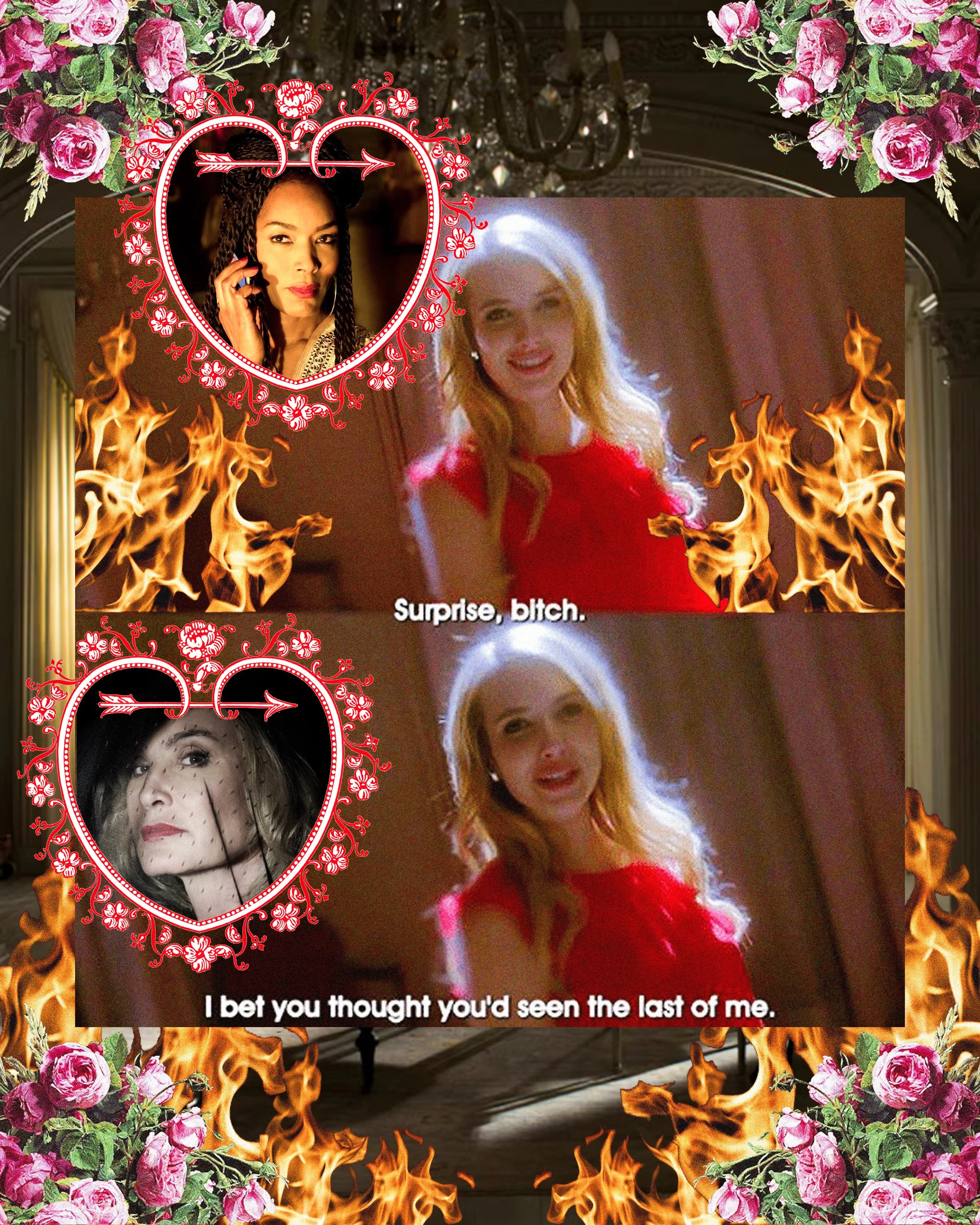
“Surprise bitch! I bet you thought you’d seen the last of me!”
In December of 2013, you couldn’t use the internet without being visually assaulted by the looping gif of Emma Roberts’ Madison Montgomery twirling around and smiling at the camera, captioned with this now iconic line. Tumblr was flooded. Twitter was drowning. The entire world was swimming in American Horror Story: Coven.
Following the successes of Murder House and Asylum, the third series of Ryan Murphy’s horror anthology follows a coven of witches in New Orleans and their struggles with power, romance, assimilation, race relations and misogyny. Featuring returning cast members Jessica Lange and Sarah Paulson, plus the additions of Academy favourites Kathy Bates and Angela Bassett, Coven remains one of the best seasons of a groundbreaking show, and today, class, we are going to look at why the series with the most heterosexual characters is actually the gayest.
First of all, I will admit that Coven is actually my favourite branch of American Horror Story, closely followed by Asylum, which I think is maybe the scariest and most involved plot-wise, and New York, which is most closely aligned to my interests - the 80s downtown New York queer art scene and the emergence of AIDS. Coven is my favourite because it is about the thing that old school queer culture used to worship above all else; women. Fabulous women. Difficult women. Powerful women. Mean women. Women who plot and carry out murder. Women who choose themselves over everything else. The kind of women that would have been played by actresses like Bette Davis, Joan Crawford, or Vivien Leigh. Complicated women. Years ago I wrote in this column about Diva Worship and the reasons that gay men have so highly valued the women in their media in the past, and I would say that Coven is a perfect modern example of this practice. ___STEADY_PAYWALL___
Whilst gay men might not necessarily need to hide their own narratives from film censorship anymore, it is still easy to see yourself in a story about outsiders, about misfits who command their own power and their own hard-won identities but still have to carve out space in a world that often still likes to pretend you don’t exist. Jessica Lange’s Fiona Goode might be a fabulous bitch, but what is going to happen to her now she’s old and alone?
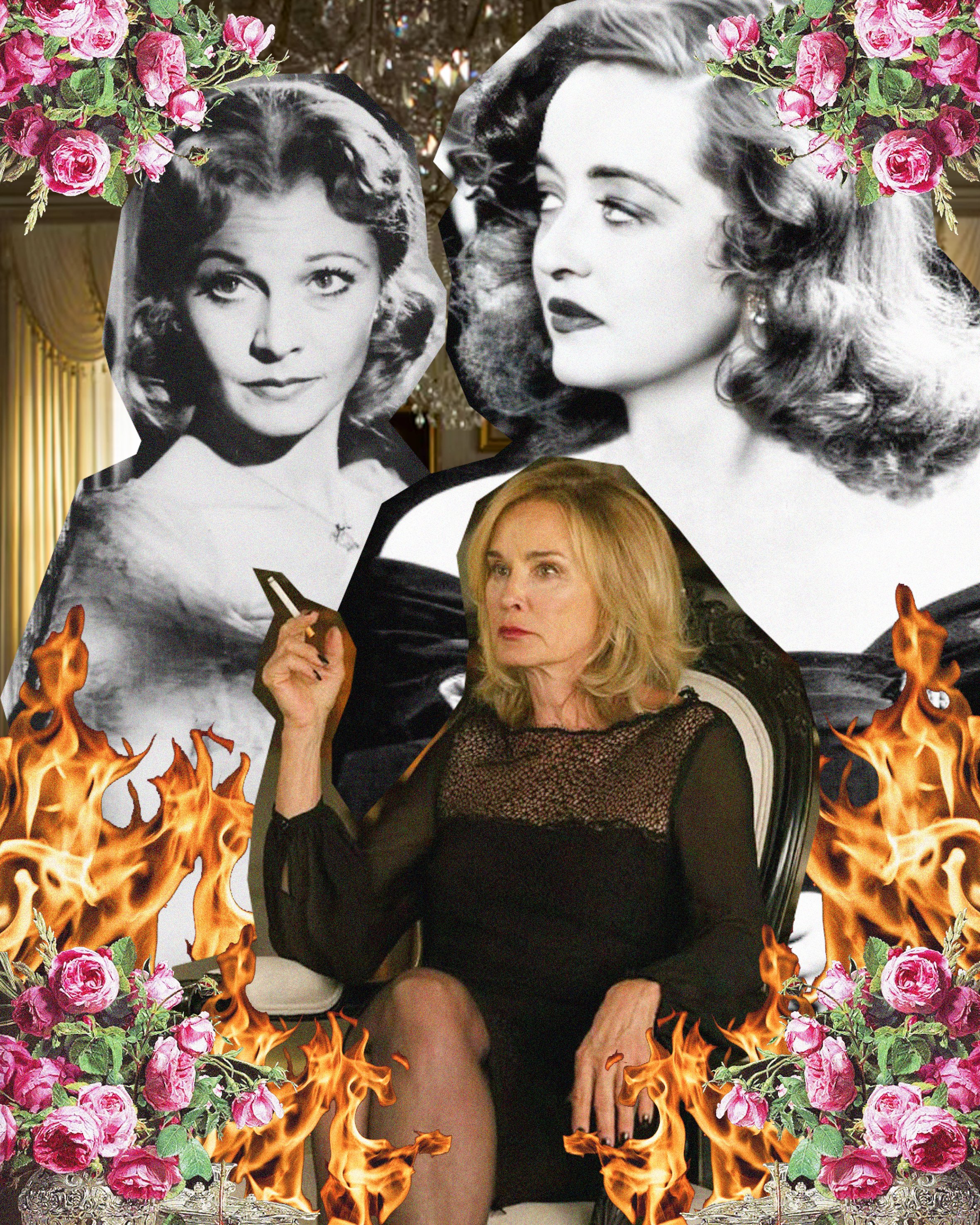
Fiona Goode is one of the best characters to come out of American Horror Story, or indeed, all of 21st century television, because she's an amalgamation of every grande dame diva that has come before her. She is a difficult star like Margo Channing from All About Eve, an increasingly unhinged wilting flower like Blanche DuBois from A Streetcar Named Desire, a vindictive schemer like Cristal Connors from Showgirls. She is Elizabeth Taylor in Boom!, Scarlet O’Hara from Gone With the Wind, Gloria Swanson in Sunset Boulevard. She is a Tennessee Williams wet dream, a George Cukor phantasmagoria, a Gore Vidal heart attack in a black Chanel dress and snoot-full of cocaine. Dripping with disdain and catty one-liners, Fiona is as aspirational (and imitable) as Faye Dunaway’s Joan Crawford camp catastrophe in Mommie Dearest is, but she has the depth it takes to be a true star: a gay icon is more than a bitch in sparkly dress. Fiona battles aging and sickness, she faces loneliness and yearns for one more great love affair. She wrestles with her own maternal instincts both for her estranged daughter and the girls in the coven, despite knowing that one day one of them will usurp her, even kill her. She fears domesticity above all else, and when she is transported to Hell it is the trendiest of heterosexual fantasies; rural homesteading with one monogamous partner, simple living, and, of course, knotty pine.
“Coven stands out amongst the rest of the AHS canon as truly a piece of queer television history that both looked to the roots of 21st and 20th century gay culture and furthered the cause by teaching younger generations what it means to partake in and create that culture.”
Fiona works so well because Jessica Lange is truly one of our greatest stars, a tornado of feverish eroticism and neurotic foibles. Starting her career off as a ditzy glamour girl in the 1976 King Kong remake, she quickly gained notoriety for her magnetic performances in sexy vehicles like Bob Fosse’s All That Jazz and Bob Rafelson’s The Postman Always Rings Twice, finally landing in a biopic of Frances Farmer, a 30s starlet who was institutionalized by her family after a troubled Hollywood career. Lange’s work here is nothing short of astonishing, both deeply feeling and resolutely defiant, with the kind of face that a camera can only dream of. She received her first Best Actress Oscars nomination for this role, but wouldn’t win until Blue Sky in 1994, where she plays a bipolar housewife with some definite shades of Fiona Goode running through this truly wild performance.
Later, she played Big Edie opposite Drew Barrymore in the Grey Gardens film, truly showing she could run the gamut between sexy ingenue and forgotten hag. After a series of great American Horror Story roles in the 2010s as a crazed housewife, a demented nun, a bitchy witch, and an amputee chanteuse, she was firmly established for the millennial audience as a star of the Ryan Murphy multiverse, culminating in her playing Joan Crawford in the deliciously-biting but historically-fudged miniseries Feud, a study on her relationship with her Whatever Happened to Baby Jane co-star Bette Davis.
Coven was also host to a few other Oscar winners and nominees, namely Kathy Bates and Angela Bassett. Bates plays Delphine LaLaurie, a society matron (and heavily mythologised serial killer) who takes joy in torturing black slaves in 19th century New Orleans, and Bassett portrays Marie Laveau, a voodoo priestess and occultist from the same period. Both characters are immortals, locked in a never-ending battle between wealthy white society and black and indigenous cultures just trying to get by. The sheer explicitness of this racial conflict feels very 2013; outrageous, but also extremely surface-level.
Marie Laveau’s zingers and stingers speak to liberation, but the joy the camera takes in lingering on the broken bodies of LaLaurie’s slaves, of a lynched child, of Laveau’s friends and family tells a different story, one that speaks of spectacle and shock value. Like all Murphy productions from this era (and to this day, honestly) a lot of scintillating narratives are set up, but very few of them get satisfying resolutions. This grand century-spanning struggle doesn’t really end, just gets put on an indefinite hold when LaLaurie and Laveau get transported to a Hell they have to share together for all eternity, a punishment for both, despite one being a racist mass-murderer and the other a community leader who just wants to protect her people.
The power dynamics between all these exciting female characters, the voodoo queen, the witch supreme, the magic school headmistress, the misfit pupils, the scheming members of the Witch’s Council, the homicidal evangelist neighbour, the grande dame of segregated New Orleans, it all comes together with such crackling vitality that it fed millenial gays for over a decade. It can be compared to other female ensemble narratives like George Cukor’s The Women or Gregory La Cava’s Stage Door, both stories about boarding houses full of cut-throat young actresses, all roiling masterpieces of tension and ambition.
You, dear reader, might be wondering why we need so many historical film references when discussing the characters and vibes of Coven as a series, and my answer to that is that it is baked into the text itself. Half way through the season, one character’s evil plan is being revealed to the coven, and it all hinges on the fact that the secret identity used was Jennifer Wooley, the name of Veronica Lake’s character in the 1942 screwball comedy I Married a Witch.
The twists and turns of this plan, delivered in the most dramatic fashion, sums up what gay culture is to me, or at least, what it used to be. Gay culture is a legacy of cinema and literature, a coterie of knowledge and niche references that can be used to identify each other or to mark oneself out as a scholar of intellectual sodomy. This is where the Myth of Gay Good Taste comes from, this culture of shared taste for Oscar Wilde, Tennesse Williams, George Cukor, William Wyler, Bette Davis, Joan Crawford, Cecil Beaton, Erte, Aubrey Beardsley, every artist, writer, actor that has been considered high brow, stylish, beautiful, they all come from the queer canon. Coven weaponises this legacy of taste and teaches us how to make it work for ourselves. In the way that RuPaul’s Drag Race teaches teenagers how to make visual references with fashion, Coven taught us how cinema can be a coded language.
Having just rewatched all of Coven before the release of American Horror Story season 13, we cannot go without comparing this 2013 vintage to the latest offering. The first two episodes of 13 are practically unwatchable, a dark, sludgey melange of grand sets and spooky body parts. If it were not for the promise of returning characters in interviews, in marketing, in studio-approved spoilers, there would be absolutely nothing in these first few episodes to draw a viewer in to follow along. If you compare this to even just the first episode of Coven, “Bitchcraft”, it feels like generational whiplash. “Bitchcraft” manages to introduce almost every major character, set up their primary wants and their flaws, establish the magical lore and the alternative histories, and make allusions to modern pop culture and how it plans to subvert its well-worn tropes. It’s incredibly dynamic and fast moving, pulpy whilst also remaining stylish and distinct from every other series airing at that time. The set design stands out, empty white halls and pillows filmed with a fish eye lens, long-legged teen witches in Urban Outfitters and Anthropologie.
On reflection, I think the reason for this dynamism in the earlier seasons comes from the commercial form in which they were released. Season 13 is a streaming series released on Disney Plus and thus has control over its own runtime and episode structure. Episodes vary in length between 35 and 23 minutes, allowing single scenes to run for whole episodes, like in Murphy’s recent streaming series The Beauty. Coven, on the other hand, has episodes that run around a standard 43 minutes, which, including advert breaks, would take up an hour’s block on network television. Pauses for commercial interludes are built into the episodes, which impacts the pacing, making everything shorter, sharper, and above all, punchier. Every act ends on a cliffhanger, or an impactful revelation, gripping the viewer so that they hopefully won’t channel surf during the break, rather staying on the edge of their seats, salivating at the thought of what could happen next. This episode structure can feel frenetic at times, but AHS IS frenetic. It’s gore and camp and pulp and shock and laughter and revulsion and empowerment all rolled up into one exciting hour. Commercialism forced Murphy to keep the story moving, and for some writers constraints like this help create art.
At the end of the day, Coven stands out amongst the rest of the AHS canon as truly a piece of queer television history that both looked to the roots of 21st and 20th century gay culture and furthered the cause by teaching younger generations what it means to partake in and create that culture. There have been pop films that have added to the lexicon like Miss Congeniality or Addams Family Values, and some that move the dial forward like Priscilla Queen of the Desert, but Coven stands out as both time capsule and instructional guide for future scholars. The only way to defeat the ongoing literacy crisis is to submerge yourselves in the Myth of Gay Good Taste and tap into the legacy of media literacy waiting for you just beneath the surface. The ancient texts are waiting to become relevant again. Surprise bitch, I bet you thought you’d seen the last of me.