
Why Do We Need To Bring Back Shame?
Words: Zara Kerfoot

Make it stand out
If you move between enthusiasm and exhaustion for the big four fashion weeks (or like me are completely reconstructing your sartorial choices due to a new penchant for estradiol valerate), you may have come across a certain piece walked this September. A coral slogan tee walked by Hari Nef that plainly declared Bring back Shame. It was the latest proclamation from Connor Ives who alongside silk floral embroidered dresses and macrame belts is well known for these prescient three-word statement pieces. AI betrayed me and I work nights are two other clever and dazzling numbers but they are eclipsed by the sensation that was Protect The Dolls.
A year later and I still think about the Protect The Dolls tee - and even more its variation created directly by doll Gogo Graham. The shirt became viral when soulless and inert performative activism and performative male discourse was flooding our screens. In a sea of essentialist talking points that completely sidelined what performativity and performance meant with relation to gender in the first place, Protect The Dolls was an announcement and an outcry that cut through the noise. ___STEADY_PAYWALL___
To my distressingly sweet natured and optimistic brain, the tee created an overdue confrontation of what actions are you all taking to help your trans friends thrive instead of survive? Something as simple as razors can be a luxury to many of us girls. Connor Ives himself was aware that fashion can ultimately feel superficial and self-serving but wanted to explore what change he could actually effect within the limits that were inherent to such a highly commodified art form.
As with Ives’ other sloganeering pieces, the new Bring back Shame tee was not born in a vacuum and represents what seems to be a new shift in the culture: an increased call to normalise shaming again. The design was likely inspired by an interview with Jacob Elordi where he suggested “the art of shame” as a lost art that needs to come back in style. This Elordian wish however already took shape a year ago when Bring Back Shame’s arguably more evil, slovenly dressed twin Bring Back Bullying made rounds through the internet, sometimes being couched as needing to return to the nostalgic days where there were normal consequences for being a fucking weirdo (gross).
“Queer rage is powerful because so many of us had to scrabble through lifetimes of shame and doubt to earn even scraps of authentic living that are taken for granted by so many.”
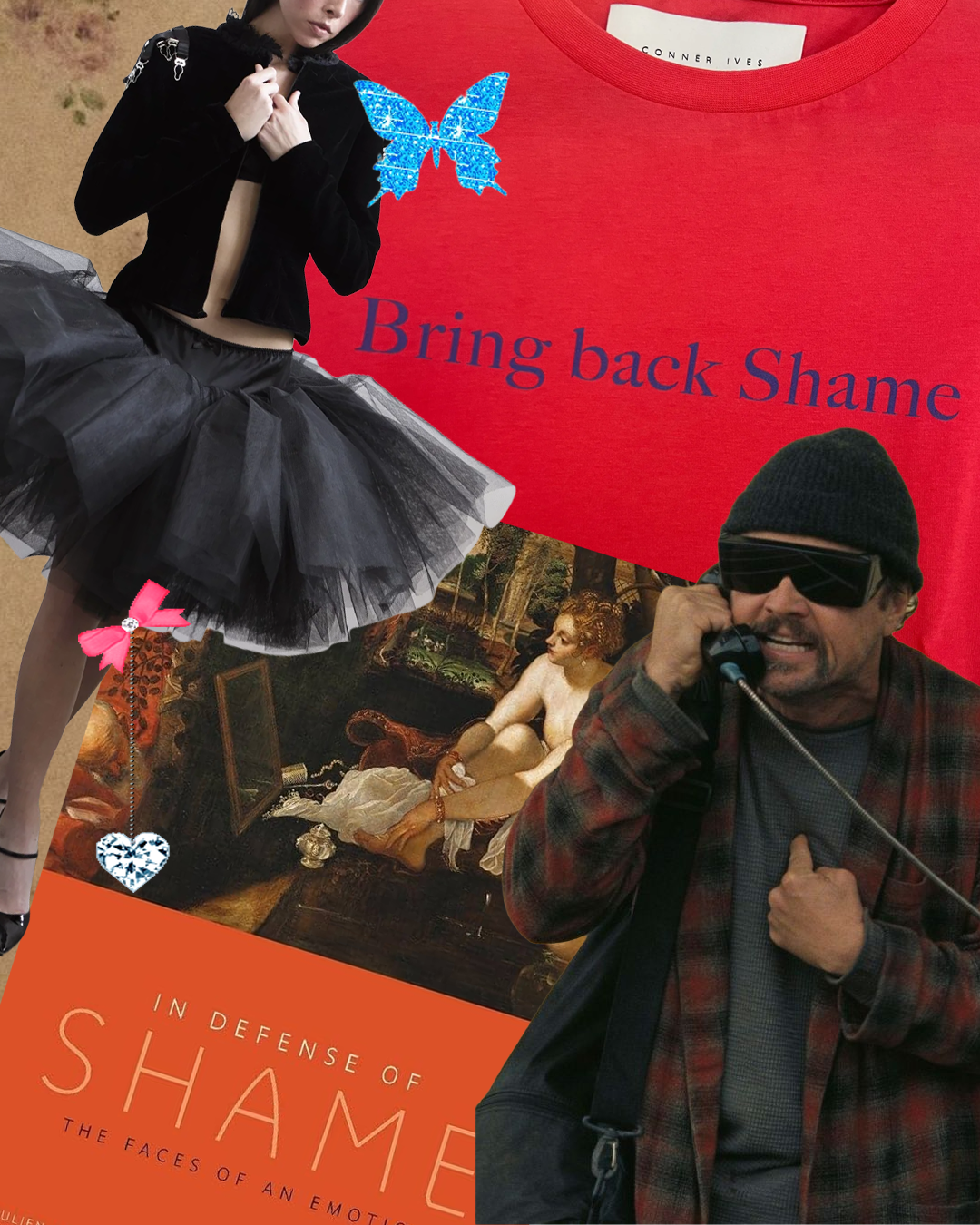
For years the cultural direction was to not feel ashamed for where we’ve been and who we are, so how do we make sense of a shift that to me seems to be steering us directly into a brick wall? In Defense of Shame: The Faces of an Emotion by Julien A. Deonna and Raffaele Rodogno defends the moral value of shame against it being intrinsically morally negative. Yes, all forms of shame concern and are directed at deep-rooted parts of the self, as opposed to guilt which is norm-based and concerns individual actions. But can we separate a brand of shame that is invasive and says that our global-self is inherently flawed, from a shame that promotes self-reflection and is value based?
Shame is everywhere right now. The girls who know, know. There never was a decade where shame of the global self was entirely overcome since our movements never prioritised the people they promised to protect in the first place. Body positivity was a structureless movement. The r-word is being made “cool again” by not just the right but by film and media that is purportedly on the left (I am looking squarely at you One Battle After Another). Corporate pride was clearly a farce (and was often trans-exclusionary in the first place so no loss there really). Shame was always there lying in wait. I don’t know if shame is something we need to bring back because it’s already here. It’s always been here.
While writing this, Erik Charlotte released her SS27 collection which I am completely in awe of. She is a genius and her work is extraordinary. The collection reflects her desire to strengthen the wearer to have “complete ownership over her own sensuality, a delicate sexual energy that feels natural and innate to the wearer instead of projected onto her against her will.” Where her previous work featured extravagant puff sleeves and addressed the spectacle and inherent unattainability of femininity, the shirred fabrics and pared back silhouettes of SS27 this time are muted, confrontational and personal. Men have always viewed trans women and women of other marginalised identities as vessels for their most debased and crude sexual fantasies. These desires are projected onto our forms and transfigured into shame when their inner fantasies of us are divulged, but the burden of shame is always thrown at us since our bodies are deemed by the world the deviant forms that need to be corrected.
So why do we need to bring shame back if it clearly never left our side? Is this new call for bringing back shame another step backward in a decade that is already defined by relentless body fascism? To this I refer back to Elordi’s dulcet words: “I wish people could experience shame a little heavier.” There is an overabundance of global shame in the air being lodged at our core selves. We have already felt the shock of it. This shame if uninterrogated is corrosive and can literally edit away the body and legitimacy everyone has a right to. Maybe a value-based shame is what needs to be brought back. Effective immediately. Now! As Hari Nef said “we really should be looking outside of ourselves at what’s Going On. and Who is Carrying on! Honey, more of Them should be ashamed of themselves!!”
I believe shame is not the determinate monolith we were instructed it was. Shame cast at the global self is alchemical and is not prophetic. Out of misplaced shame can be born anger, rage and transformation. For years I did not understand how much anger had accumulated in my body from years internalised and externalised shame. It stifled a need for authenticity - a need present in all of us - that was starved of love, worthiness and care. Everyone on this planet has a right to take in the authentic living they know they deserve.
Queer rage is powerful because so many of us had to scrabble through lifetimes of shame and doubt to earn even scraps of authentic living that are taken for granted by so many. It is refined, potent and loaded with the information and energy necessary to effect those who are “Going on” and “Carrying on” to learn how to pipe it.