From Miu Miu’s Aprons to Skirt over Trousers - Is Fashion Glamourising the Kitchen?
Words: Daniella Parete Clarke
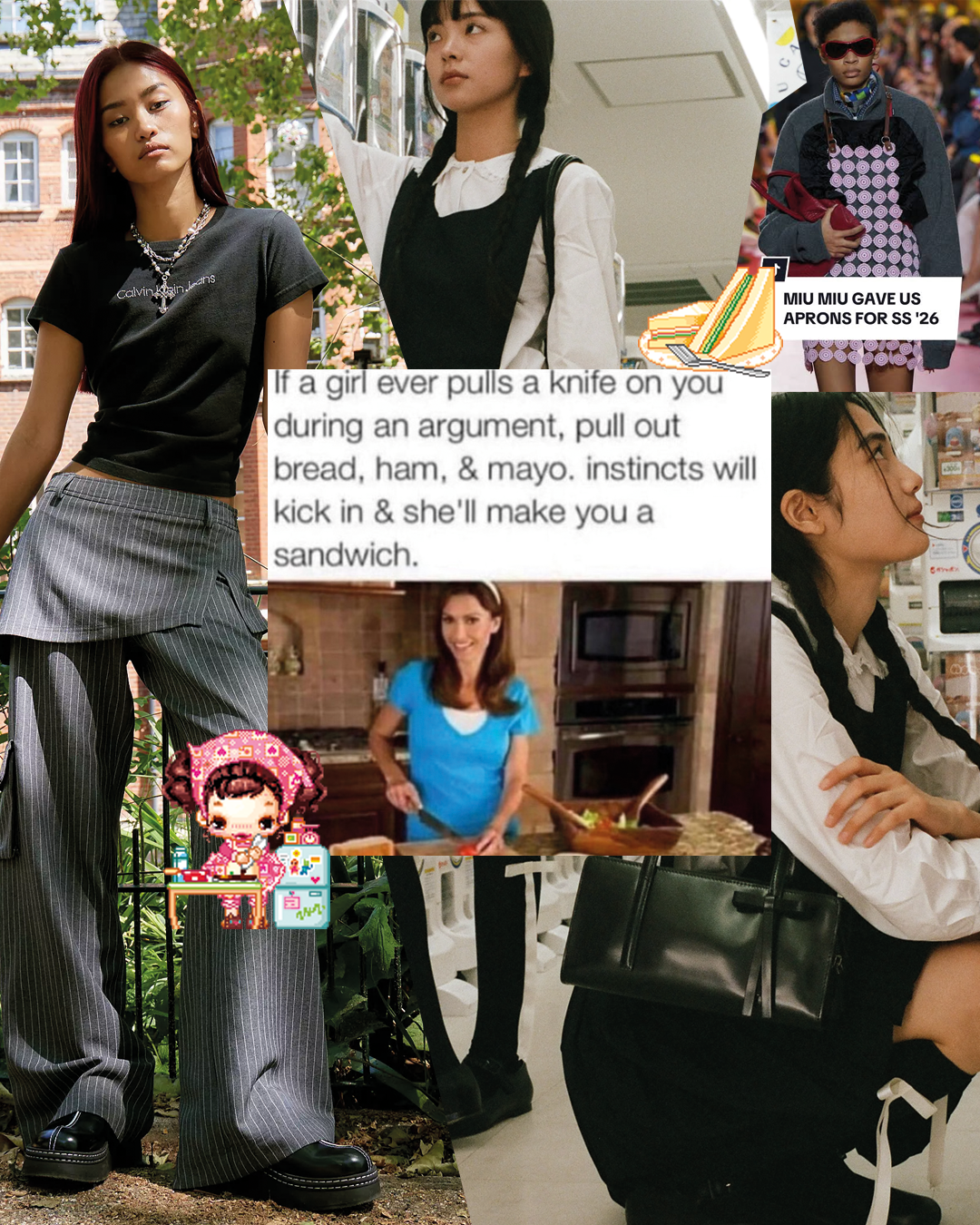
Don’t be alarmed if the most stylish girl you know is suddenly dressing like a housemaid. Aprons are the year’s most surprising fashion trend, popping up in every form, from frilly pinafores to Charlize Theron’s recent clear-plastic skirt (PPE chic). Though apron-trousers first appeared on runways several seasons ago, the look has only recently hit the mainstream, aka, the aisles of Primark.
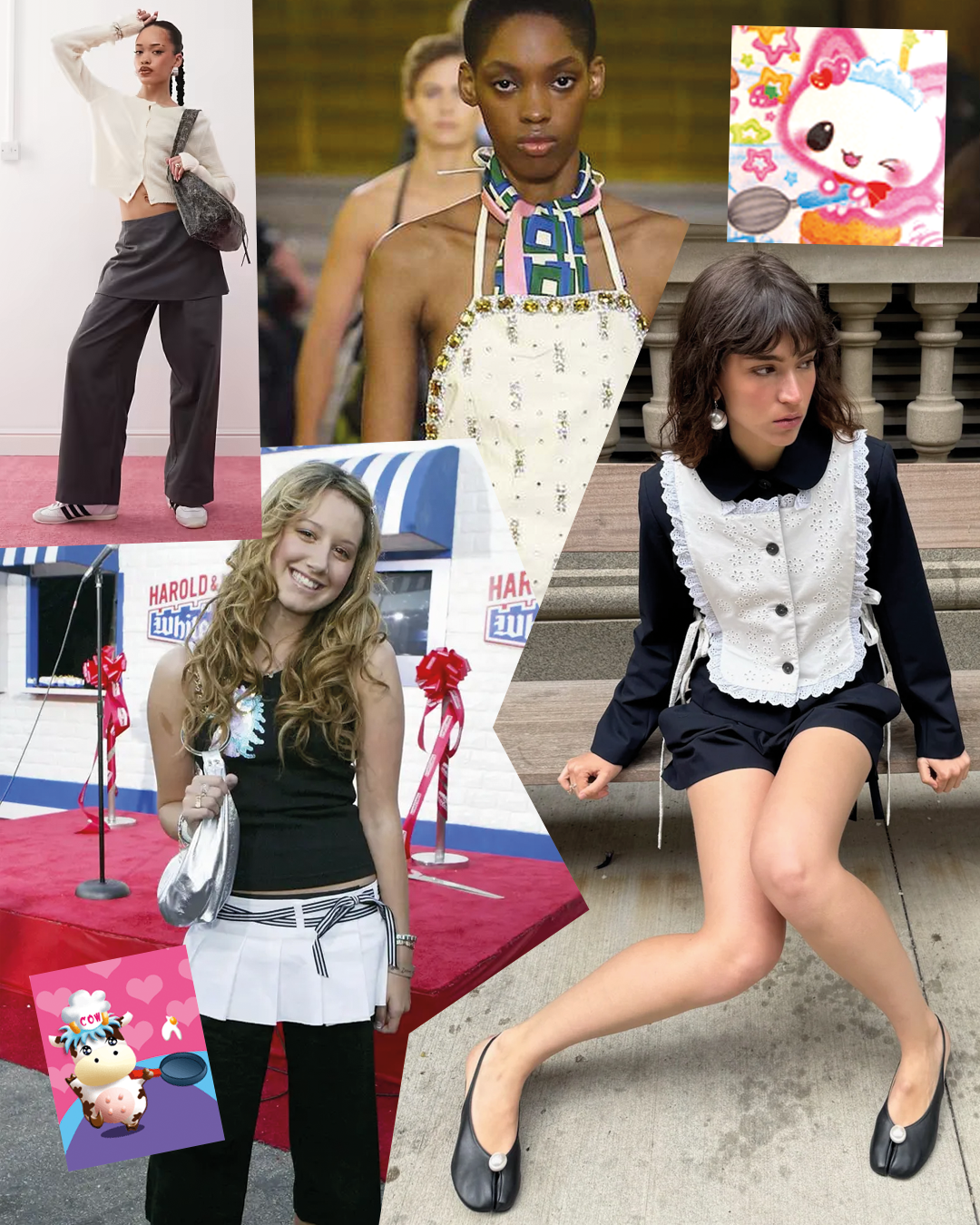
Fashion has pinny fever – but why? Some consider it the latest mutation of Gen Z’s Y2K obsession. After all, ‘skants’ were once the domain of Ashley Tisdale, who used to walk the red carpet in bedazzled dresses with bootleg jeans. Yet the most common link drawn by internet commentators has been not to Tisdale, but to housewives. This was cemented by Miu Miu’s SS26 show, where Miuccia Prada dressed models in a procession of aprons – some sturdy, some floral, some leather; all of them controversial. The discourse began: is this a feminist reclamation of a conservative symbol, or has high fashion gone trad wife mad?
It wasn’t always this way. Molly Rooyakkers, the data analyst in Amsterdam who runs the Instagram account @style.analytics, points out that the ‘visual language’ now associated with trad wives was once called ‘cottagecore’. “During the pandemic, cottagecore visuals had us excited by the idea of leaving our apartments and living an off-grid life,” Rooyakkers tells me.
While the aesthetics overlap – typing both terms into Pinterest will conjure images of crisp cotton dresses, pastel washing lines and pie – their political persuasions could not be more different. Not only did cottagecore signal an environmentalist slant, it was intertwined with lesbian culture. Now, ‘trad wife’ is shorthand for rightwing ideals, and nods to an old-fashioned notion of women being best suited to the domestic sphere – what the Victorians called ‘the angel of the house’. Despite this association, most of the women pounding the pavement in Issey Miyake aprons and ruffled smocks are not exactly figureheads of the natalist movement.
“The rise of brands like Dôen has New York City women dressing like they’re in Little House on the Prairie,” says Rooyakkers. “Not everyone wearing a prairie dress is aware of this, but the trad wife influence is present nonetheless.”
___STEADY_PAYWALL___
“Can an apron ever be subversive, or is it restricted by its own symbolic weight?”
For those tapped into a certain algorithm, the trad wife label needs no introduction. For everyone else: it describes a married woman who stands for traditional values, embracing her ‘natural’ duties as a homemaker. Since creators Nara Smith and Hannah Neeleman, better known as Ballerina Farm, first blew up on TikTok for making things ‘from scratch’ and homesteading, the trad wife has kept a firm grip on the zeitgeist. This year’s book of the summer is Caro Claire Burke’s Yesteryear, about a trad wife on a perilous mission to portray her life as perfect to her Instagram followers.
“Fashion is always reading the room,” Emily Kirkpatrick explains to me, the writer behind the newsletter I Heart Mess. “Brands are seeing this rise of anti-woke, trad wife influencers: Gen Z women who don’t want to work and want a man to take care of them. They’re noticing that there is a demographic for this quiet-luxury life of leisure.”
Ironically, this desire for an existence beyond the drudgery of a nine-to-five has shades of socialism. “It’s like, you're so close to class consciousness and then you retreat into Stepford Wives instead,” Kirkpatrick mocks. She explains that fashion houses, like other major corporations, are willing to court conservative aesthetics to appease MAGA customers. And what better symbol for our polarised times than the trad wife apron?
Yet Mandy Lee, a self-described ‘fashion oracle’ who posts under @oldloserinbrooklyn, argues that the apron trend is more indicative of utility taking centre stage in fashion. Due to rising costs in luxury, cash-strapped consumers are demanding more for their money. “People are yearning for longevity and usefulness in their clothes. Historically, aprons were a protective layer, they served a purpose. It’s not just something to look cute in,” she notes over email.
“The trad wife aesthetic is extremely niche, even for those in conservative spaces,” Lee continues, marking it as ‘chronically online’ territory. “We can’t minimise the impact the idea has had on young women, but I don’t think it’s so influential that the Miu Miu show is an ode to trad wife culture.”
Rather than being swept up with online discourse, Lee suggests, we should acknowledge it’s unlikely Mrs Prada has been radicalised by Ballerina Farm videos. Kirkpatrick agrees that ‘Miuccia’s design code has always been uniforms’ – so women’s workwear is nothing new. Still, even if this wave of design is more about utility than harking back to Fifties values, myriad influences make up a fashion moment.
Such is the case with Sandy Liang’s AW26 collection. The designer presented several aprons, inspired by both the Studio Ghibli film Kiki’s Delivery Service and ‘the aprons her mother and grandmother used to wear’.
Zooming out from our 2026 image of the tradwife in her red-pilled final form, Kirkpatrick wonders if there is a slightly Freudian undercurrent at play here beneath the cultural fixation on aprons. In other words, is this a mommy thing?
“In fashion and every industry, I think a lot can be reduced to, ‘I want my mommy back,’” Kirkpatrick notes. “People always yearn for mommy.” And the apron is symbolic of a capable woman who takes care of everything. The skirt-over-trousers look, meanwhile, resembles a barista’s half-apron, calling to mind a host of jobs and societal roles that signal competence, cleanliness and hospitality, in both senses of the word.
This thread can be traced back to at least the 18th century: another era when aprons were worn for fashion as well as function. Ladies would don ornately embroidered lace aprons as accessories to oversee the completion of chores by their staff (whose own aprons were significantly less decorative), symbolising their role as ruler of the domestic realm.
“It’s basically the premise of Desperate Housewives,” Kirkpatrick comments. She refers to fashion and pop culture’s perennial fascination with the Madonna-whore complex, “which is basically the mommy-whore complex.” The fact that this dichotomy can be so easily merged into one being is part of the appeal. Charli xcx invoked this very concept in her music video for ‘Wink Wink’; the singer flirts with domesticity, completing a series of chores in increasingly skimpy outfits. “It’s not a coincidence that fans call their favourite pop stars mother,” Kirkpatrick adds.
All things considered, can an apron ever be subversive, or is it restricted by its own symbolic weight? In Lee’s view, the trend is not being adopted by those on the right, because the nature of conservatism precludes them from jumping on trends that are fresh and progressive. The girls strutting about in skirts over trousers, and the Miu Miu-buying women of the world, are people for whom the trad wife is just a character in a novel. “Conservatives are only wearing aprons at home. It’s not being worn out the house for fashion purposes,” Lee notes.
She continues: “I have a pair of Paloma Wool apron pants that are part of my style uniform. I love them because they cover my butt – I am a modest dresser, but my politics could not align less with conservatism.”
Kirkpatrick agrees that any trend can be subversive, provided you do it your own way. “You can take these aesthetics that gesture towards conservatism and subvert them,” she finishes. “That, in my opinion, is the whole point of fashion. That’s what feels punk. That’s what feels radical.”